

What Decorations Look Best on Coloured Buttercream?
Editorial TeamLast Updated: 18 November 2026
Quick Summary
Choose buttercream decorations by contrast, texture and tone: a pale pastel base needs bold shapes, a deep saturated base needs light or metallic accents, and a busy base needs quiet decorations. Pick a decoration colour that appears nowhere in the buttercream itself so it registers as a deliberate choice.
- Let crusting buttercream form its thin skin for 20 to 30 minutes before adding decorations.
- Sugar paste toppers slide on wet, glossy buttercream, so let the frosting crust first.
- Fine sugar strands stick best scattered over a just-piped surface and left alone.
- Avoid nonpareils on soft frosting because their colour coating bleeds within an hour.
- Give piping a structural role and decorations a focal role to avoid clutter.
Table of Contents
- Why the Buttercream Base Decides Your Decorations
- Buttercream Colour Combinations That Make Decorations Pop
- Matching Sugar Paste Toppers to Your Colour Palette
- Sprinkles for Buttercream Cakes: What Actually Sticks
- Piping Tips and Texture: Adding Detail Without Clutter
- Troubleshooting Colour Bleeding and Separation
- How Lighting and Photography Change Your Cake Finish
- Ordering Toppers That Match Your Buttercream
- Frequently Asked Questions
Why the Buttercream Base Decides Your Decorations
The colour of your buttercream is the stage your buttercream decorations perform on. Get it right, and even simple toppers look expensive. Get it wrong, and the fanciest sprinkles vanish into the background.
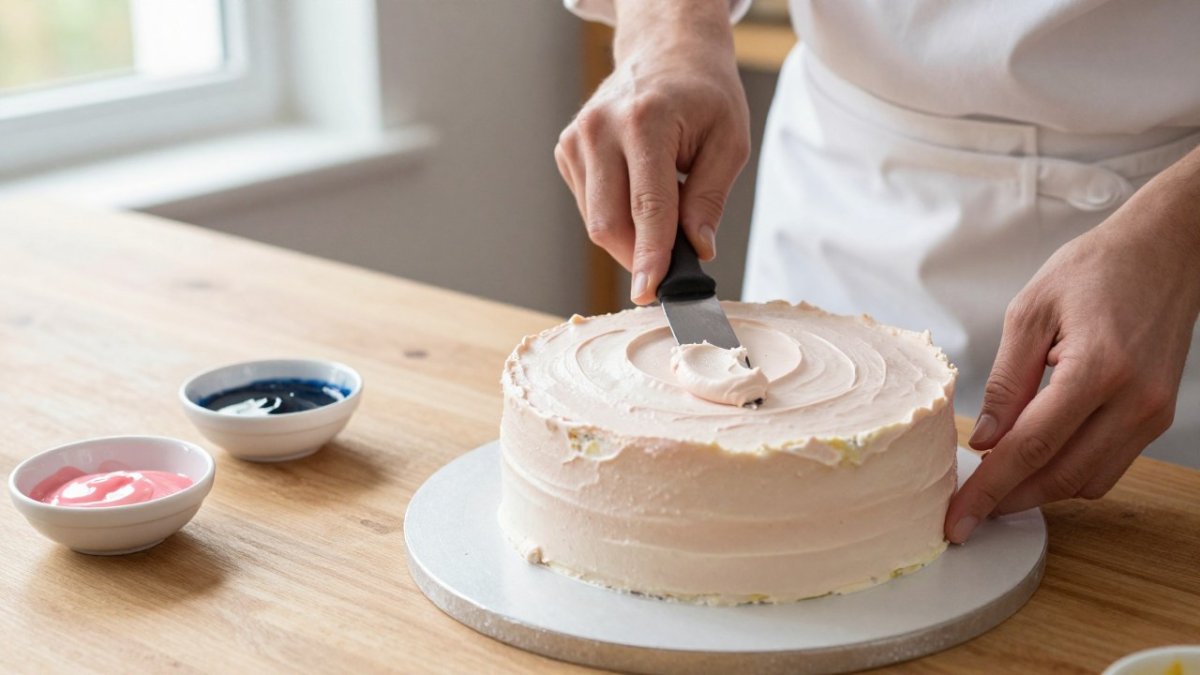
This is the part most guides skip. They show you how to colour buttercream, then leave you guessing what to put on top. The pattern is always the same: the base decides everything.
Choosing cake decorations for coloured buttercream comes down to three things: contrast, texture and tone. A pale pastel base needs bold shapes. A deep, saturated base needs light or metallic accents. A busy base needs quiet decorations.
One more thing worth knowing early. The finish of your buttercream matters as much as the colour. A crusting buttercream forms a thin skin that grips decorations well. A meringue-based buttercream stays softer and needs lighter toppers.
If you are still working out how to get an even colour in the first place, our guide on how to colour buttercream frosting evenly walks through the method step by step.
Buttercream Colour Combinations That Make Decorations Pop
Some colour pairings work every single time. Others fight each other no matter how carefully you place them. The difference comes down to contrast and colour theory.
Contrast Rules That Work Every Time
Contrast is what makes a decoration readable from across the room. Use these pairings as your starting point:
- Pastel base, bold topper: soft pink buttercream with deep red or navy decorations
- Dark base, light topper: navy or deep green buttercream with white, cream or gold
- Warm base, cool accent: peach or yellow buttercream with mint or sky blue
- Neutral base, any colour: ivory or pale grey buttercream takes almost anything
Primary colours (red, blue, yellow) give you the strongest contrast. Secondary colours (green, orange, purple) sit softer against each other. Pastel shades need more saturation on top to hold their own.
Pairing Shades for an Ombre Finish
An ombre effect changes how you choose decorations. If your cake fades from light to dark, keep toppers consistent across the whole cake. One shape, one finish, one size.
Why? The gradient is already doing the visual work. Adding varied decorations on top creates clutter.
A good rule: pick your darkest ombre shade, then choose a topper colour that appears nowhere in the gradient. Cream or gold works beautifully against most ombre palettes.
Matching Sugar Paste Toppers to Your Colour Palette
Sugar paste accents are a versatile choice for coloured buttercream. They can be made in a range of shades and sit flat against the frosting for a clean finish.
The trick is matching, not clashing. Pull one colour from your buttercream and repeat it in the topper, or go one shade lighter for a soft, tonal look.
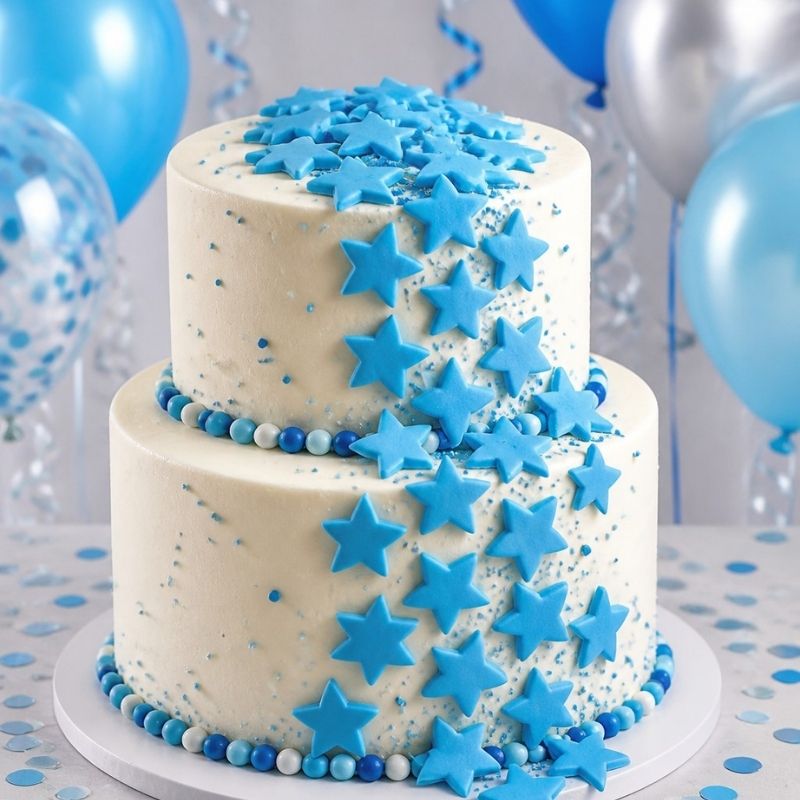
Our handmade edible coloured stars come in assorted vibrant colours and are made from prime sugar paste that is vegan, vegetarian, and dairy and gluten free.
For a full walkthrough on getting them to stay put, see our guide on how to attach edible sugar paste decorations to buttercream.
Watch out: sugar paste toppers placed on wet, glossy buttercream will slide. Let the frosting crust for 20 to 30 minutes first.
Sprinkles for Buttercream Cakes: What Actually Sticks
Sprinkles are the cheapest way to add colour and texture to a buttercream cake, but they are also the most misunderstood.
That single fact explains almost every sprinkle failure. Fine sugar strands sink because they have too little surface area to resist soft frosting. Heavy shapes roll off because gravity beats friction.
Here is how the main types behave on coloured buttercream, and what to do about each:
- Fine sugar strands: best scattered over a just-piped surface, then left alone. On a crusted base they bounce off. Use them for a soft, matte finish rather than sharp colour contrast.
- Sugar stars and shaped sprinkles: press gently into slightly crusted buttercream with a dry fingertip. They hold their shape and read clearly against both pastel and deep bases.
- Edible pearls and dragées: place by hand, one at a time. A scatter will leave half of them on the worktop. They suit formal designs and photograph well because they catch light.
- Nonpareils: avoid on soft or glossy frosting. The colour coating bleeds within an hour, especially in a warm kitchen, and leaves a halo around each dot.
- Edible glitter: sits on the surface and does not adhere well to buttercream at all. Apply just before serving, or fix with a tiny dab of clear piping gel if the cake needs to travel.
Colour matters as much as texture. On a deep navy or forest green base, white and gold sprinkles read as deliberate; pastel sprinkles disappear.
Timing is the other variable. Sprinkles added immediately after piping stick best but can sink. Sprinkles added after crusting sit on top but may shed in transit.
Our 40 handmade edible coloured stars are ready to use with no preparation needed, and they are suitable for commercial cake decorators, bakeries and hobbyists alike.
Watch out: sprinkles applied to a warm cake in a hot kitchen will slide or bleed within minutes, so let the buttercream come back to room temperature and firm up slightly before decorating.
Piping Tips and Texture: Adding Detail Without Clutter
Piping is where coloured buttercream either looks intentional or looks busy. The mistake most bakers make is treating piping and decorations as separate decisions. They are not.
The practical rule is to give piping a structural role and decorations a focal role. A border, a shell edge, a simple swirl around the base, these frame the cake without demanding attention.
Here is how piping colour should relate to the buttercream base:
- Tone-on-tone piping: match the base one shade lighter or darker. This adds texture without adding a new colour, which keeps the decoration palette clean. It suits ombre cakes especially well, because the gradient already carries the colour story.
- Contrast piping: use a colour that appears in the decorations but not in the base. This ties the toppers to the cake and stops them looking applied as an afterthought.
- Metallic piping: gold or silver piping on a deep base reads as celebration; on a pastel base it can look heavy. Use it sparingly and keep the decorations simple.
Nozzle choice changes the texture, and texture changes how colour reads. A star nozzle produces ridges that catch light and make a colour look richer than it is.
A few practical pointers that make a real difference:
- Keep piping pressure even. Uneven swirls read as mistakes, not as texture.
- Leave the centre of the cake clear for toppers. Piping under a decoration is wasted effort and adds clutter.
- Pipe a test swirl on a saucer first. Coloured buttercream often looks different piped than it does in the bowl.
- Use a star nozzle for piping blooms that echo the shape of your decorations, so the two elements rhyme rather than compete.
Piping blooms work especially well on ombre cakes, where the gradient carries the colour and the piping adds depth without introducing a new hue.
If you want to build your skills first, our guide on simple piping techniques for birthday cakes covers the basics.
Troubleshooting Colour Bleeding and Separation
Colour bleeding is the most common heartbreak in coloured buttercream work. Deep reds and blacks are the usual culprits, especially in humid kitchens or when the cake sits out for hours.
Here is how to fix the most frequent problems:
| Problem | Likely Cause | Fix |
|---|---|---|
| Colour bleeding into decorations | Too much liquid colour | Switch to gel colouring, use less |
| Buttercream splitting | Cold butter or fast mixing | Warm slightly, mix slowly |
| Toppers sliding off | Frosting too wet | Let it crust before decorating |
| Faded colour after a day | Poor quality colouring | Use gel or paste, store cool |
| Sprinkles turning soggy | Soft frosting plus time | Add sprinkles close to serving |
Separation, where buttercream looks curdled, usually means the butter was too cold or the mixture was beaten too fast. Warm the bowl slightly and mix on low.
For a deeper fix-it list, our troubleshooting guide for common buttercream mistakes covers bleeding and separation in detail.
How Lighting and Photography Change Your Cake Finish
Your cake will look different in your kitchen, on a party table, and in a photograph. Lighting changes how colour saturation reads, and this catches bakers out constantly.
Warm indoor lighting pushes reds and yellows forward and dulls blues. Cool daylight does the opposite. If you are photographing the cake, shoot near a window with indirect light and avoid overhead bulbs.
A few quick wins:
- Photograph before the party, not after hours under warm lights
- Turn off the flash, it flattens texture
- Use a plain background so the buttercream colour reads true
- Shoot from slightly above to show the decoration layout
If the cake will sit out for hours, keep decorations simple and add delicate items like edible glitter at the last moment.
Ordering Toppers That Match Your Buttercream
The safest route to a polished finish is ordering toppers made to match your palette.
When you order, tell the maker your buttercream shade and your occasion. All our decorations are 100% edible, handmade, and free from dairy and gluten, so they suit guests with allergies and dietary requirements. Our designs are handmade and can be custom made or ordered.
Our award-winning designs have earned recognition including a Bronze Award in the Free From Food Awards 2025. If you are planning a celebration and want decorations that fit your colour scheme, our quick order form makes it simple.
Matching decorations to coloured buttercream takes a little planning, but the result is a cake that looks professionally finished. At Simply Toppers, we make handmade edible decorations that are vegan, vegetarian, and free from dairy and gluten, so every guest can enjoy them. Our sugar paste toppers are ready to use and come in a wide choice of colours to suit your palette.
Frequently Asked Questions
Can you put edible toppers on buttercream?
Yes, and sugar paste toppers are one of the easiest ways to finish a coloured buttercream cake. Add them once the buttercream has crusted slightly, so the surface holds the decoration without it sinking. Press gently rather than pushing hard, and place toppers in the last hour before serving so they keep their shape. Handmade edible stars and buttons, like those from Simply Toppers, are ready to use and suitable for commercial cake decorators and hobbyists.
What colour sprinkles go with coloured buttercream?
Pick sprinkles that either contrast with the buttercream or echo one shade already in the palette. A pastel buttercream works well with brighter sprinkles for a lift, while a deep, saturated buttercream suits white, gold or metallic sprinkles that stand out. Avoid sprinkles that sit too close in tone to the base, as they disappear in photos. For sprinkles for buttercream cakes, apply them to freshly piped buttercream so they grip before a crust forms.
How do you stop cake decorations clashing with buttercream?
Limit yourself to one dominant buttercream colour and one accent. Choose toppers in a shade that either matches the accent or sits opposite it on the colour wheel for deliberate contrast. Keep edible glitter and pearls to a single tone rather than mixing several, and let piping texture carry the detail. If you are unsure, test a small patch of buttercream with your chosen topper before committing to the whole cake.
How do you match cake decorations to a party theme?
Start with the theme's two strongest colours, then choose a buttercream shade that supports them rather than competing. Use sugar paste toppers in the theme colours, and keep sprinkles or edible pearls neutral so the cake still looks cohesive. If the theme is subtle, such as a baby shower, pastel buttercream with white or pearl accents reads more polished than a full rainbow. Ordering custom toppers in your chosen shades gives the closest match.
