

How to Get a Smooth Cake Finish Without Fondant
Editorial TeamTable of Contents
- Why a Smooth Cake Finish Without Fondant Is Easier Than You Think
- What You'll Need for a Smooth Cake Finish
- How to Crumb Coat a Cake Before Smoothing
- How Long to Chill a Cake Before Frosting
- How to Smooth Buttercream on a Cake
- How to Smooth Buttercream Without a Scraper
- Common Mistakes That Ruin a Smooth Cake Finish
- Conclusion
- Frequently Asked Questions
Last Updated: 15 October 2026
Why a Smooth Cake Finish Without Fondant Is Easier Than You Think
Getting a smooth cake finish without fondant comes down to three things: a firm crumb coat, a properly chilled cake, and the right smoothing motion. That's it. You don't need sugar paste, a professional turntable, or years of practice to get a finish that looks shop-bought.
At Simply Toppers, we've been making handmade edible decorations since 2013, and we've seen thousands of home bakes that just needed a better crumb coat to look brilliant. Most people blame their buttercream when the real problem is temperature. Cold cake, room-temperature frosting, light pressure. Get those three in order and the finish follows.
Below, we'll walk through exactly how to crumb coat, chill, and smooth a cake, plus what to do if you don't own a scraper. The common mistakes section at the end is the one most guides skip, and it's where most finishes fall apart.
What You'll Need for a Smooth Cake Finish
You need less kit than you'd think. A turntable helps, but a plate that spins works too. Here's the short list:
- A cooled cake, level on top, on a cake board
- Buttercream at room temperature, soft but not runny
- An offset palette knife
- A bench scraper or a straight-sided tool
- A tall jug of hot water and a clean cloth
- A cake turntable (optional but very useful)
Two things matter more than tools. First, your cake must be completely cool. Warm cake melts buttercream on contact. Second, your frosting must be soft enough to spread but firm enough to hold a ridge. If it slumps off the knife, it's too warm.
For anyone baking for a celebration with dietary needs, the finish matters as much as the flavour. A clean, smooth base gives your decorations something to sit on properly.
How to Crumb Coat a Cake Before Smoothing
A crumb coat is a thin first layer of buttercream that traps loose crumbs so your final coat stays clean. Skip it and you'll chase crumbs around the cake forever.
Here's how to crumb coat a cake in five steps:
- Dollop a few tablespoons of buttercream on top of the cooled cake.
- Spread it thin across the top and down the sides with your palette knife.
- Scrape most of it back off. You want a see-through layer, not a thick one.
- Smooth it roughly. It doesn't need to look good.
- Chill the cake until the crumb coat feels firm to a light touch.
The layer should be thin enough that you can still see the cake through it in places. That's normal. A thick crumb coat makes the final coat bulky and harder to smooth.
How Long to Chill a Cake Before Frosting
Chill the cake for at least 30 minutes before adding the final coat, or until the crumb coat is firm and dry to the touch. In a warm kitchen, give it closer to an hour.
This step is where most people rush. Cold buttercream holds its shape, so your scraper glides instead of dragging. Warm buttercream smears and pulls.
A few practical notes:
- A fridge is fastest, but the cake picks up fridge smells. Cover it loosely.
- A cool room works if your kitchen isn't warm.
- If the cake feels tacky, it isn't ready. Wait longer.
Once the crumb coat is firm, you're ready for the final layer. If you're decorating for a party and want the finish to last, a well-chilled base keeps everything stable while the cake sits out.
How to Smooth Buttercream on a Cake
Smoothing buttercream is about pressure and angle, not strength. Press too hard and you'll scrape the cake bare. Use light, even strokes and let the scraper do the work.
Spread a generous layer of buttercream over the top and sides. Then hold your scraper at a slight angle against the side of the cake and turn the turntable slowly. Keep the scraper still and let the cake rotate past it. Wipe the blade clean between passes.
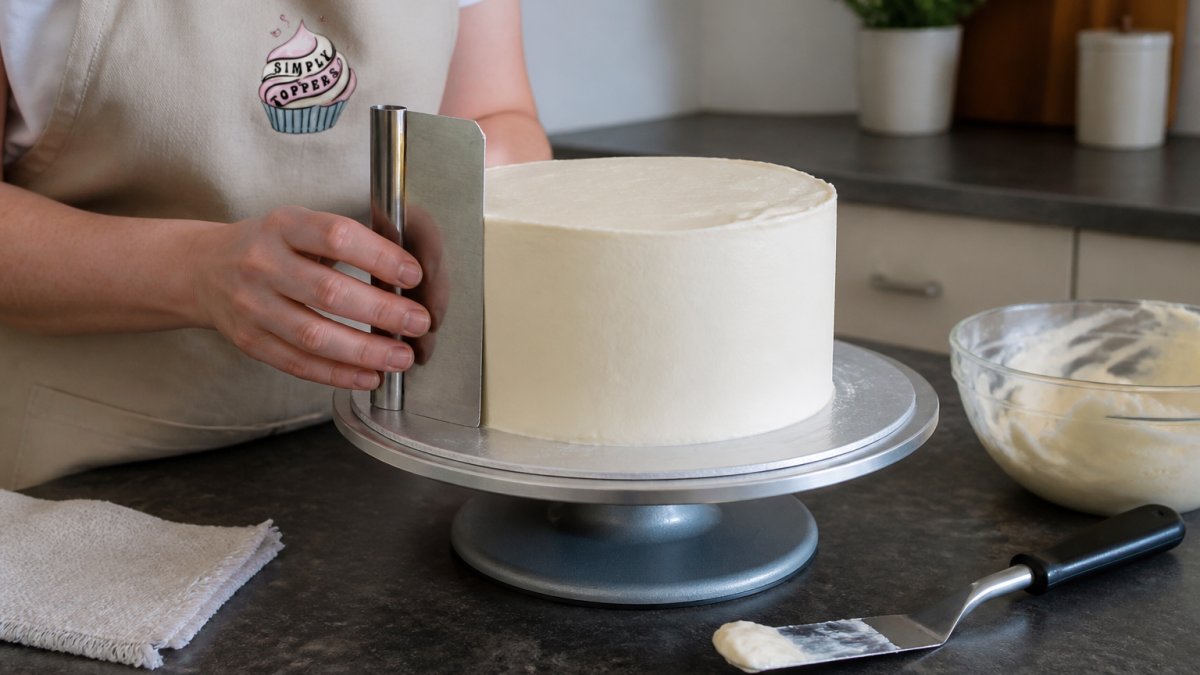
For the top, pull the excess buttercream in towards the centre in one smooth sweep. Then tidy the edge where the top meets the side.
How to Smooth Buttercream Without a Scraper
No scraper? A few everyday items do the same job. The trick is finding something with a long, straight, flat edge.
Try these:
- A clean plastic ruler
- The flat side of a large metal spatula
- A stiff piece of card, cut straight
- The back of a butter knife for small cakes
Use them exactly as you would a scraper: hold at a slight angle, keep it still, and turn the cake. Warm the edge in hot water first, then dry it.
The finish won't be quite as crisp as a proper scraper gives, but it's close. For a home bake, nobody will notice the difference once decorations go on top.
Common Mistakes That Ruin a Smooth Cake Finish
Most rough finishes trace back to the same handful of errors. Fix these and your cakes improve straight away.
| Mistake | What Happens | The Fix |
|---|---|---|
| Frosting a warm cake | Buttercream melts and slides | Cool the cake fully first |
| Skipping the crumb coat | Crumbs show through the top layer | Always crumb coat and chill |
| Buttercream too warm | It smears instead of smoothing | Chill it briefly, then stir |
| Pressing too hard | Scraper digs into the cake | Use light, even pressure |
| Not cleaning the scraper | Ridges build up on the edge | Wipe between every pass |
One more thing most guides miss: your cake board matters. If the cake sits on a wobbly board, every pass of the scraper shifts it. A firm, flat board makes the whole job easier.
Conclusion
A smooth cake finish without fondant is a skill, but not a hard one. Crumb coat, chill, then smooth with light pressure and a warm scraper. That's the whole method, and it works whether you're baking for a birthday, a baby shower, or a quiet weekend treat.
Once your base is smooth, the fun part starts: decorating. Our handmade, edible toppers are 100% vegan, vegetarian, and free from dairy and gluten, and each one is made by hand. They're award-winning designs, including recognition at the Free From Food Awards 2025 and Scotland's Prestige Awards 2025/2026, and they simply press onto a freshly smoothed cake.
Ready to finish your bake? Use our Quick Order Form to find the perfect topper for your occasion, and let us help you make it extra special.
Frequently Asked Questions
How do you get a smooth cake finish without fondant?
Build the cake in layers: a thin crumb coat first, then a chill until the buttercream is firm, then a thicker final coat smoothed with a scraper held at a slight angle. Work in short strokes, wiping the blade clean between passes. A turntable makes this far quicker, but you can turn the cake stand by hand. If the surface still looks uneven, chill again for 15 to 20 minutes and repeat the smoothing.
How do you stop crumbs showing through buttercream?
The crumb coat does this job. Apply a thin layer of buttercream, roughly 3 to 4mm, that traps loose crumbs against the cake. Chill it for at least 30 minutes until it feels firm to a light touch, then add your final coat on top. If you skip this step, or rush it while the base is still soft, dark crumbs will lift into the top layer and show through.
Can you get a smooth finish with cream cheese frosting?
Yes, but cream cheese frosting is softer than buttercream, so it needs more chilling between coats. Keep it cold, work in thin layers, and return the cake to the fridge whenever the surface starts to feel slack. A frosting with a higher butter-to-cream-cheese ratio holds its shape better. If the mix feels loose, chill it for 20 minutes before you start smoothing.
How do you fix air bubbles in buttercream?
Air bubbles usually come from over-whipping or from buttercream that was too cold when mixed. Press them out with a palette knife or the flat edge of your scraper, then smooth over the area with a warm blade. For the next batch, mix on a slower speed for the final minute and let the buttercream sit for 10 minutes before using it so trapped air can rise.