

How to Safely Ship Cake Toppers: A 2026 Guide
Editorial TeamTable of Contents
- Why Sugar Paste Toppers Need Special Care in Transit
- Best Packaging for Sugar Paste Decorations
- Step-by-Step Guide: How to Safely Ship Cake Toppers
- Protecting Handmade Toppers from Moisture
- How to Post Fragile Cake Toppers: Choosing a Delivery Service
- Common Packing Mistakes That Break Toppers
- Conclusion: Ship Cake Toppers with Confidence
- Frequently Asked Questions
Last Updated: September 8, 2026
Sugar paste decorations are delicate by nature. A beautifully modelled unicorn or hand-piped floral spray can crack, smudge, or lose its shape before it ever reaches the cake. Learning how to safely ship cake toppers is about more than wrapping something in bubble wrap and hoping for the best. It requires understanding how sugar paste responds to movement, temperature, and moisture during transit.
At Simply Toppers, we have packed and posted thousands of handmade decorations since 2013, and we have learned exactly what works and what ends in crumbs. This guide shares reliable methods so your toppers arrive looking their best. We will cover protective packaging, moisture control, and choosing a delivery service that treats fragile parcels with care.
Why Sugar Paste Toppers Need Special Care in Transit
Sugar paste, also known as fondant, is pliable when fresh but becomes brittle as it dries. A topper that has been left to set for a few days is firm enough to hold its shape, yet that same firmness makes it vulnerable to sharp impacts. Drop a box onto a hard floor and the force travels straight through the packaging to the decoration inside.
Temperature makes the problem worse. Warm conditions soften the paste and can cause fine details to droop or stick to whatever touches them. Cold conditions make the paste stiff and more prone to snapping. The goal of safe packing is to keep the topper immobilised, insulated from shocks, and protected from humidity changes throughout its journey.
Best Packaging for Sugar Paste Decorations
The best packaging for sugar paste decorations follows one simple principle: the topper must not touch the sides of the outer box at any point. If it can rattle, it can break.
Start with a rigid cardboard box that gives at least 5 centimetres of clearance on every side of the topper. A box that fits snugly offers no cushioning. Inside that box, create layers of protection:
- Bubble wrap for general cushioning around the base and any wired elements
- Tissue paper (unprinted) placed directly against the sugar paste surface to prevent marking
- Kraft paper or packing peanuts to fill all empty space so nothing shifts
- A corrugated insert or cardboard divider to keep the topper suspended away from the box walls
For toppers with delicate vertical elements, such as standing figures or tiered cakes, pack them upright and support the base firmly. Laying them flat can put pressure on the most fragile points.
Step-by-Step Guide: How to Safely Ship Cake Toppers
There is a reliable sequence for packing a sugar paste topper that minimises risk. Follow these steps in order and you will give your decoration the best possible chance of arriving intact.
Step 1: Prepare the Topper Surface
Let the topper dry completely before packing. A surface that is still soft will mark, smudge, or deform even with careful wrapping. Depending on the thickness of the paste, drying can take anywhere from 24 to 72 hours. Check that the underside is firm, not just the top.
Once dry, place a single layer of tissue paper over any areas that might come into contact with packaging. Do not use printed paper, as the ink can transfer onto the paste.
Step 2: Create a Protective Cradle
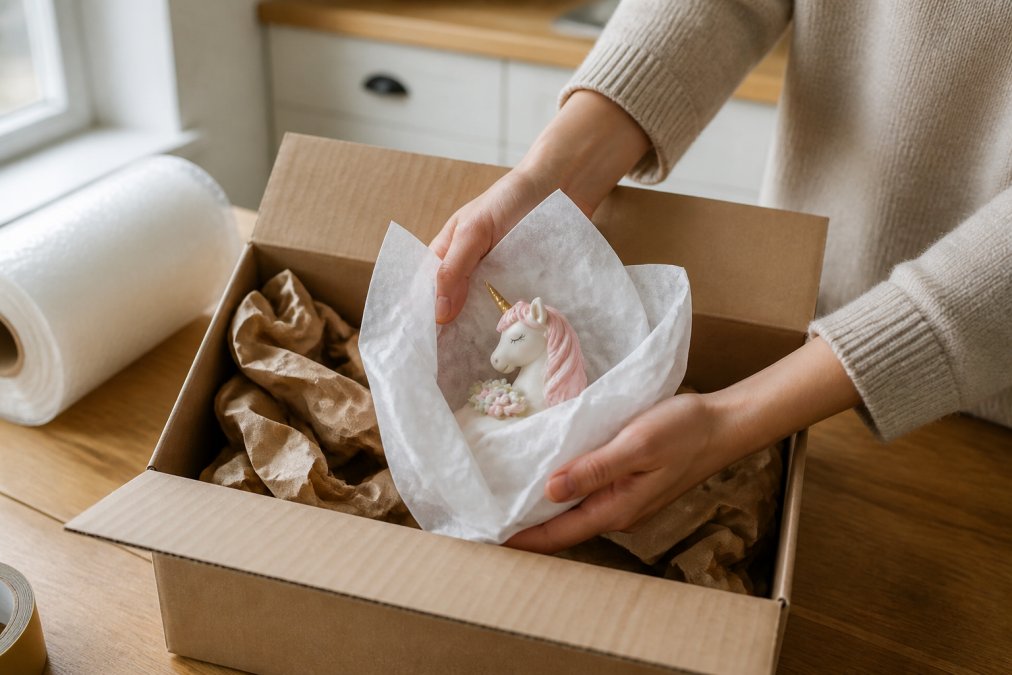
The most effective way to protect a topper is to suspend it so it never touches the box. Cut a piece of corrugated cardboard slightly smaller than the box interior. Wrap the topper loosely in bubble wrap, then position it on the cardboard and secure it with tape across the base only. Never press tape onto the sugar paste itself.
Add crumpled tissue or packing peanuts around the topper within the box so it sits in a cradle of soft material. The topper should feel firmly held when you gently shake the box.
Step 3: Secure the Outer Box
Seal the box with strong parcel tape along all open edges. Write "FRAGILE" and "THIS WAY UP" on at least two sides, though be aware that carriers do not always honour these markings. The packing itself is your real protection.
A common mistake is overpacking the box until the lid bulges. If the box cannot close flat, the structure is compromised and the contents are at greater risk. Keep the box rigid and the contents cushioned.
Protecting Handmade Toppers from Moisture
Protecting handmade toppers from moisture is essential because sugar paste is sensitive to humidity. Damp conditions cause the surface to become sticky, which ruins fine details and can make colours bleed. Dry conditions, by contrast, can cause cracking. For guidance on packing fragile items, consult resources on packing fragile items.
The answer is not to add moisture absorbers, as some crafters assume. Silica gel packets can actually draw too much moisture out of the paste, leaving it brittle. Instead, wrap the topper in a layer of tissue paper, then seal it inside a food-safe plastic bag or wrap before placing it in the box. This creates a stable microclimate around the topper and protects it from sudden changes in humidity during transit.
Timing also matters. Avoid posting on days of extreme weather, whether heavy rain or a heatwave, if you can plan around it. A topper sitting in a warm delivery van for several hours is at far greater risk than one travelling in mild conditions.
How to Post Fragile Cake Toppers: Choosing a Delivery Service
How to post fragile cake toppers comes down to balancing speed, cost, and care. For most home bakers and small businesses, a tracked next-day or 48-hour service is the sensible choice. The longer a parcel is in transit, the more handling it endures and the greater the chance of damage.
When comparing services, consider these points:
- Tracking so you and the recipient can monitor progress
- Signature on delivery to ensure the parcel is not left unattended
- Compensation cover for loss or damage, which varies between carriers
- Saturday delivery options if the topper is needed for a weekend celebration
For particularly valuable or intricate toppers, some couriers offer a dedicated or priority service with reduced handling. This costs more but can be worth it for a one-off commission or a wedding cake centrepiece. Check the carrier's terms on fragile items, as many exclude sugar craft from their standard damage cover.
Common Packing Mistakes That Break Toppers
Most damaged toppers share the same avoidable errors. Knowing what these are is half the battle.
- Skipping the drying time. Packing a topper that is still soft is the single most common cause of smudged or deformed decorations.
- Using a box that is too small. Without clearance on all sides, there is no room for cushioning and impacts transfer directly to the topper.
- Leaving empty space. Any gap inside the box allows movement. Fill every void with crumpled paper or packing peanuts.
- Taping directly onto the sugar paste. Adhesive can pull at the surface and leave marks that cannot be removed.
- Choosing a slow delivery service. More time in transit means more handling and more risk.
- Ignoring the weather forecast. Extreme temperatures and humidity can undo even the best packing.
Conclusion: Ship Cake Toppers with Confidence
Shipping sugar paste decorations does not have to be a gamble. Dry the topper fully, create a cushioned cradle that keeps it away from the box walls, protect it from moisture with a sealed barrier, and choose a tracked service that minimises transit time. Follow those steps and your toppers will arrive ready for the cake.
If you would rather leave the packing to the professionals, Simply Toppers has over a decade of experience in creating handmade, 100% vegan and gluten-free decorations. Every topper is packed with care, so you can order with confidence for birthdays, baby showers, and every celebration in between. Browse the collection and get your decorations ordered in time for your next special occasion.
Frequently Asked Questions
What is the best packaging material for fragile sugar paste toppers?
The best packaging for sugar paste decorations combines a rigid outer box with soft cushioning inside. Wrap each topper in tissue paper or bubble wrap, then place it in a snug container so it cannot slide around. Fill any gaps with crumpled paper or eco-friendly packing peanuts. A sturdy cardboard box, at least 5 cm larger than the topper on every side, provides the necessary crush protection during transit.
How do I prevent sugar paste toppers from breaking during transit?
Breakage usually happens when toppers rattle inside the box or when the box gets crushed. To ship cake toppers safely, create a snug cradle using soft materials like tissue paper or bubble wrap. Tape the inner box shut securely, then place it in a larger outer box with padding on all sides. Write 'FRAGILE' clearly on the outside to encourage careful handling.
Should I use Royal Mail or a courier for shipping edible decorations?
For small toppers under 2 cm thick, Royal Mail's Large Letter service is often cost-effective and reliable. For larger or more fragile pieces, consider a tracked courier service such as Parcelforce or DPD. Always choose a service with tracking and compensation cover, and check delivery times so your topper does not sit in a depot over a warm weekend, which risks moisture damage.
How do I protect sugar paste toppers from humidity during delivery?
Moisture is the enemy of sugar paste. Wrap each topper in a food-safe plastic bag or cling film before adding tissue paper, creating a barrier against humidity. Add a small food-safe silica gel sachet to the box to absorb excess moisture, but keep it away from direct contact with the topper. Avoid posting on very humid days where possible.