

Safe Allergen Free Cake Decorations: 7 Top Picks
Editorial TeamTable of Contents
- What Makes a Cake Decoration Truly Allergen Free?
- Vegan Gluten Free Cake Decorations: What to Look For
- 1. Handmade Sugar Paste Toppers: The Safest Allergen Free Cake Decorations
- 2. Edible Glitter and Shimmer Accents
- 3. Fresh Fruit and Compote Decorations
- 4. Allergy-Friendly Chocolate and Candy Melts
- 5. Meringue Kisses and Kissing Sweets
- 6. Rice Paper and Wafer Decorations
- Matching the Decoration to the Occasion
- Best Practices for Allergy-Safe Cake Decorating
- Frequently Asked Questions
Last Updated: September 10, 2026
What Makes a Cake Decoration Truly Allergen Free?
A cake decoration is truly allergen free when it contains none of the 14 major allergens that UK law requires to be declared, and when it has been made in a way that avoids cross-contamination. For anyone searching for safe allergen free cake decorations, that definition matters more than any label on the front of a packet.
This guide from Simply Toppers breaks down the decorations that reliably work for allergy-friendly bakes, from handmade sugar paste toppers to fresh fruit, and explains what to check before anything touches the cake. We have been making vegan, dairy-free and gluten-free sugar paste decorations since 2013, so we know where the hidden risks sit.

The 14 allergens that must be declared under Food Standards Agency allergen guidance are celery, cereals containing gluten, crustaceans, eggs, fish, lupin, milk, molluscs, mustard, peanuts, sesame, soybeans, sulphur dioxide and tree nuts. A decoration can look innocent and still contain one of them.
The Allergens That Matter Most in Cake Decorating
Milk, eggs, gluten and nuts cause the most problems in decorating. Fondant often contains milk powder or gelatine. Royal icing uses egg white. Chocolate may carry soy lecithin or traces of nuts from shared production lines. Sprinkles can include wheat starch or shellac.
Here is where each common decoration tends to hide an allergen:
| Decoration | Common Hidden Allergen | Safer Alternative |
|---|---|---|
| Standard fondant | Milk powder, gelatine | Vegan sugar paste |
| Royal icing | Egg white | Aquafaba or vegan icing |
| Chocolate | Milk, soy, nut traces | Dairy-free chocolate |
| Sprinkles | Wheat starch, shellac | Sugar-based glitter |
| Marzipan | Almonds | Sugar paste shapes |
The practical takeaway: read the full ingredient list, not the marketing claim. "Free from" on the front means little if the back lists milk or gluten.
Vegan Gluten Free Cake Decorations: What to Look For
Vegan gluten free cake decorations must satisfy two conditions at once: no animal-derived ingredients and no gluten-containing cereals. That rules out gelatine, shellac, egg white, milk powder, wheat starch and most commercial fondants.
Three checks separate a genuinely safe decoration from a risky one:
- Ingredient list: Look for sugar, glucose, water, vegetable fat, colourings and flavourings. Nothing else should appear.
- Production statement: Ask whether the decorations are made on a line that also handles nuts, milk or gluten. Shared lines are where cross-contamination happens.
- Allergen labelling: Under UK rules, prepacked food must emphasise the 14 allergens in the ingredients list (food.gov.uk). If nothing is emphasised, check whether the product is prepacked at all.
A common mistake is assuming "vegan" also means gluten free. It does not. Vegan chocolate can still contain barley malt, and vegan icing can include wheat-derived glucose syrup.

1. Handmade Sugar Paste Toppers: The Safest Allergen Free Cake Decorations
Handmade sugar paste toppers are the safest option for allergy-friendly cakes because the ingredient list is short and the maker controls what goes in. Our own toppers are made from vegan, vegetarian, dairy-free and gluten-free sugar paste, so the base carries none of the common allergens.
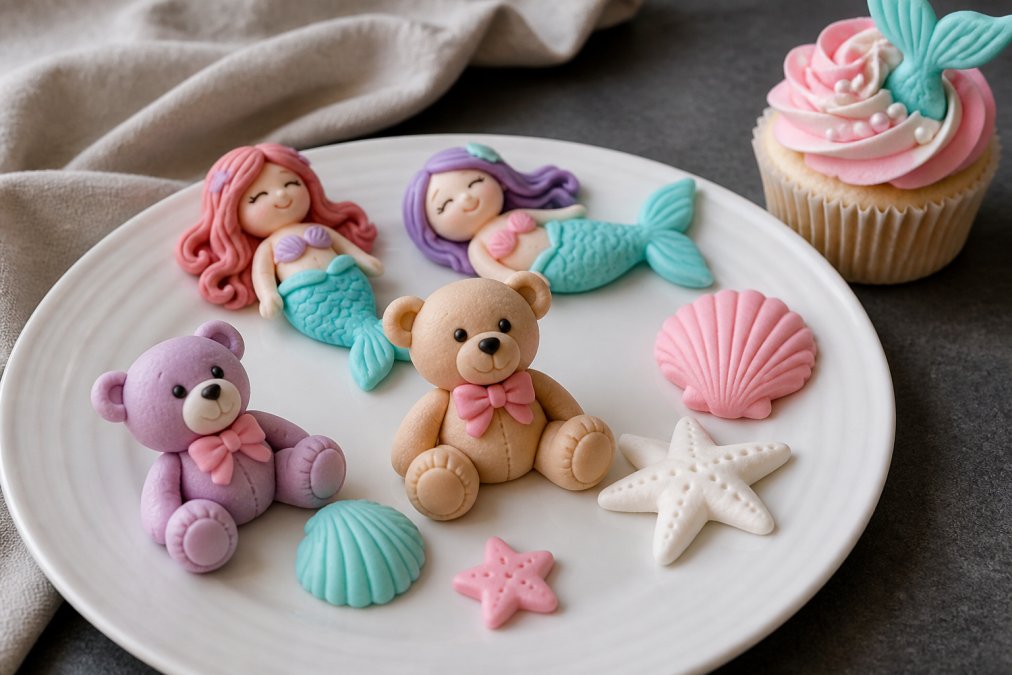
What makes sugar paste work so well is its simplicity. Sugar, glucose, water and a little vegetable fat form the base. Colour comes from edible food colours, and any shimmer comes from edible glitter rather than plastic or shellac. There is no egg, no milk and no wheat.

Our 2 Mermaid Tails Cake Toppers come in two sizes and a range of colours, finished with edible glitter, and they sit happily on buttercream, fondant or royal icing. For a birthday spread, the 12 Edible Coloured Brick Men Cupcake Toppers give you twelve identical pieces at £7.99, which keeps portioning simple when you are feeding a group with mixed dietary needs.
The one drawback worth knowing: sugar paste is soft, so it does not like heat or damp. Keep toppers in their packaging until you are ready to place them.
2. Edible Glitter and Shimmer Accents
Edible glitter is safe when it is made from sugar, starch or mica-based food colouring, and unsafe when it is the craft glitter sold in stationery shops. That distinction is the whole game here.
Genuine edible glitter carries a food-grade specification and lists its ingredients like any other food. Craft glitter is plastic or metal foil and must never go on a cake. If a product does not state "edible" and list ingredients, treat it as decoration only.
Shimmer dusts and lustre powders follow the same rule. Look for edible lustre, not the metallic powders sold for craft use. A light dusting gives a professional finish without adding an allergen risk, provided the base is food-grade.
3. Fresh Fruit and Compote Decorations
Fresh fruit is naturally free from the 14 declarable allergens, which makes it one of the most reliable decorations available. Strawberries, raspberries, blueberries and sliced kiwi need no label check at all.
The catch is preparation, not the fruit itself. A knife used to cut a peanut butter sandwich and then a strawberry introduces a risk that no ingredient list will warn you about. Keep a separate board and knife for allergen-free prep, and wash fruit under running water before it goes anywhere near the cake.
A fruit compote, gently cooked with a little sugar and cooled, gives you a glossy finish that holds its shape on top of buttercream. It also travels better than loose berries at a party.
4. Allergy-Friendly Chocolate and Candy Melts
Allergy-friendly chocolate means dairy-free chocolate that is also made away from nuts and gluten. Standard milk chocolate fails on the first count, and many dark chocolates carry a "may contain milk" warning from shared equipment.
Candy melts are popular for moulded shapes, but they are one of the trickier options. Many brands contain milk solids or soy lecithin, and the "may contain" statements vary widely between batches. Check every new pack, even if you have bought the same brand before.
For a reliable result, choose a dairy-free chocolate that states its allergen status clearly, and melt it gently over a bain-marie rather than in a microwave where hotspots can scorch it. Moulded shapes set firm and hold their detail well.
5. Meringue Kisses and Kissing Sweets
Traditional meringue is made from egg white and sugar, so it is off the table for anyone avoiding egg (peer-reviewed research). Vegan meringue made with aquafaba, the liquid from a tin of chickpeas, solves that problem and behaves almost identically once baked.
Kissing sweets, the small piped meringue drops often used to finish a cake, can be made the same way. Pipe small rounds, bake low and slow until they lift cleanly from the paper, and store them in an airtight tin. They stay crisp for days in dry conditions.
The honest limitation: aquafaba meringue is more sensitive to humidity than the egg version. On a damp day it can turn sticky, so add them close to serving rather than the night before.
6. Rice Paper and Wafer Decorations
Rice paper and wafer paper are made from rice flour, potato starch and water, which keeps them naturally free from gluten, dairy and egg. They are one of the easiest ways to add printed messages or delicate shapes to a cake.
Wafer paper softens quickly once it touches moisture, so place it last and avoid pressing it into wet buttercream. Rice paper holds up slightly better and can be cut into shapes with clean scissors.
Both are best treated as a finishing touch rather than a structural decoration. They will not hold a shape under their own weight, and they do not survive refrigeration well.
Matching the Decoration to the Occasion
Different celebrations call for different decorations, and the allergen profile stays safe across all of them when you choose sugar paste, fruit or rice paper. Here is how the options line up:
| Decoration | Best For | Key Allergen Note | Typical Cost |
|---|---|---|---|
| Sugar paste toppers | Birthdays, baby showers | Vegan, dairy and gluten free | From £3.99 |
| Edible glitter | Finishing touches | Must be food-grade | Varies |
| Fresh fruit | Summer parties | Naturally allergen free | Low |
| Dairy-free chocolate | Moulded shapes | Check "may contain" | Varies |
| Vegan meringue | Delicate finishes | Humidity sensitive | Low |
| Rice paper | Printed messages | Gluten, dairy and egg free | Low |
For a baby shower, our 12 Coloured Vegan Small Teddy Cupcake Toppers start at £3.99 and suit a large batch of cupcakes without a big outlay. For a themed birthday, the Glitter Sea Life Cake Decorations give you sixteen pieces in an ocean theme, all made from the same vegan sugar paste base.
Best Practices for Allergy-Safe Cake Decorating
Clean surfaces and separate tools do more for safety than any single product choice. Allergen residue on a board, a rolling pin or a piping bag can undo an otherwise careful bake.
Work through this checklist before you start:
- Wash hands and all surfaces with hot, soapy water
- Use a dedicated board and knife for allergen-free prep
- Read the full ingredient list on every decoration, every time
- Check for "may contain" statements on shared-line products
- Keep decorations in sealed packaging until needed
- Add delicate items like meringue and wafer paper close to serving
- Label the finished cake clearly if guests will help themselves
The thing nobody tells you about allergen-safe decorating is that the risk usually comes from the kitchen, not the product. A clean bench and a separate knife solve most of it.
Simply Toppers has been making handmade edible decorations since 2013, and our range is vegan, vegetarian, dairy-free and gluten-free throughout. We picked up a Bronze Award in the Free From Food Awards 2025 in the grocery section and a Gold in the Halloween section, alongside Scotland's Prestige Awards 2025/2026 for Cake Decorating Service of The Year.
Decorating for a guest with allergies should not mean settling for a plain cake. The challenge is finding decorations you can trust without spending hours reading labels, and that is exactly where Simply Toppers helps. Our handmade sugar paste toppers are 100% edible, suitable for vegans and vegetarians, and free from dairy and gluten, with designs for birthdays, baby showers and seasonal celebrations. If you have something specific in mind, our toppers are handmade and can be custom made or ordered to suit your theme. Get started with Simply Toppers and find the perfect decoration for your next bake using our Quick Order Form.
Frequently Asked Questions
How can I tell if cake decorations are allergen-free?
Check the packaging for a full ingredient list and allergen statement. In the UK, the 14 major allergens must be emphasised in bold within the ingredients. Look for explicit 'free-from' claims such as dairy-free, gluten-free or nut-free. For loose or handmade decorations without packaging, ask the maker for written allergen information. Reputable suppliers like Simply Toppers provide full ingredient and allergy details for every product, so you can check before you buy.
Are all vegan cake decorations also gluten-free?
No. Vegan means no animal-derived ingredients, but a product can still contain gluten from wheat-based thickeners, colourings or carriers. Always check for a separate gluten-free claim. Simply Toppers' sugar paste toppers are both vegan and gluten-free, so they suit multiple dietary needs at once. If you are baking for someone with coeliac disease, look for products that state they are made without gluten-containing ingredients and have controls in place to avoid cross-contamination.
What should I look for on food labels regarding allergens in the UK?
UK food law requires the 14 major allergens to be listed and emphasised in the ingredients list, usually in bold. These include celery, cereals containing gluten, crustaceans, eggs, fish, lupin, milk, molluscs, mustard, peanuts, sesame, soybeans, sulphur dioxide and tree nuts. For non-prepacked foods, allergen information must be available in writing or clearly signposted. If a decoration has no label, treat it with caution and ask the supplier for a full allergen breakdown.
How do I avoid cross-contamination when decorating allergy-friendly cakes?
Start with clean equipment and a dedicated workspace. Wash hands, bowls and utensils thoroughly before you begin. Keep allergen-containing ingredients separate and use clean tools for each element. If you are decorating a cake for someone with a severe allergy, avoid using the same piping bags, boards or knives that have touched nuts, dairy or gluten. Store finished decorations in sealed containers away from open allergen sources. When in doubt, use pre-packed certified toppers to reduce risk.
Are there specific brands that specialise in nut-free cake toppers?
Several UK suppliers make nut-free cake decorations, but you should always verify the allergen statement on the specific product. Simply Toppers, for example, makes handmade sugar paste toppers that are vegan, dairy-free and gluten-free, with full ingredient information available. Nut-free claims vary by product, so check the packaging or contact the supplier directly. If you are buying from a smaller maker, ask about their kitchen practices and whether they handle nuts on the same premises.