

How to Ensure Cross Contamination Free Baking
Editorial TeamTable of Contents
- Why Cross Contamination Free Baking Matters More Than Ever
- Understanding Gluten-Free Baking Cross-Contamination
- Separate Baking Utensils for Allergies: What to Keep Apart
- Cleaning Kitchen Surfaces for Gluten-Free Baking
- Checking Food Labels for Allergens Before You Bake
- Choosing Allergen-Friendly Cake Decorations
- Common Mistakes That Break Cross Contamination Free Baking
- Conclusion: Building Habits That Keep Every Bake Safe
- Frequently Asked Questions
Last Updated: October 5, 2026
Why Cross Contamination Free Baking Matters More Than Ever
For anyone baking for a child with a food allergy, the stakes are higher than most recipe books admit. When you learn how to ensure cross contamination free baking, you're not just following a trend. You're protecting someone at your table.
At Simply Toppers, we've supplied handmade, gluten-free and vegan cake decorations since 2013. That work has taught us one thing above all: the little details decide whether a bake is safe.
Here's the good news. You don't need a second kitchen or expensive equipment. You need a system.
This guide walks you through that system, step by step. We'll cover where gluten hides, which tools you can never share, how to clean properly, and how to read labels without second-guessing yourself.
The Food Standards Agency allergen guidance is clear that even tiny traces of an allergen can trigger a reaction in sensitive people. So "just a crumb" is never just a crumb.
Below, we'll show you exactly how to build habits that hold up, batch after batch.
Understanding Gluten-Free Baking Cross-Contamination
Gluten-free baking cross-contamination is the transfer of gluten from a surface, tool, or ingredient onto food that should be gluten-free. It happens through crumbs, flour dust, shared utensils, and even hands. Such microscopic particles behave much like raw juices in a kitchen environment, necessitating a similar level of vigilance as preventing meat cross contamination to ensure that every surface remains safe for all dietary requirements.
Most home bakers worry about obvious sources. The hidden ones cause more trouble.
Where Gluten Hides in a Baking Kitchen
Flour dust is the biggest culprit. It settles on worktops, shelves, and utensils long after you've finished baking.
Other common hiding places include:
- Wooden spoons and chopping boards with scratches
- Sieves and colanders with fine mesh
- Shared butter, jam, or spreads
- Baking trays with baked-on residue
- Tea towels and oven gloves
- Rolling pins with cracks
- Cake tins with rough edges
Each of these can hold onto gluten and pass it on.
How Much Gluten Is Too Much?
For someone with coeliac disease, there is no safe amount of gluten. Even trace amounts can cause harm.
That's why "a little bit won't hurt" is dangerous advice. The NHS information on coeliac disease explains that people with the condition must avoid gluten completely, not simply reduce it.
So the goal is simple: zero transfer. Not "mostly clean." Not "probably fine."
Separate Baking Utensils for Allergies: What to Keep Apart
The safest approach is a dedicated allergy-safe kit. This means separate baking utensils for allergies, stored apart and never used for anything else.
It sounds fussy. In practice, it takes one drawer and a marker pen.
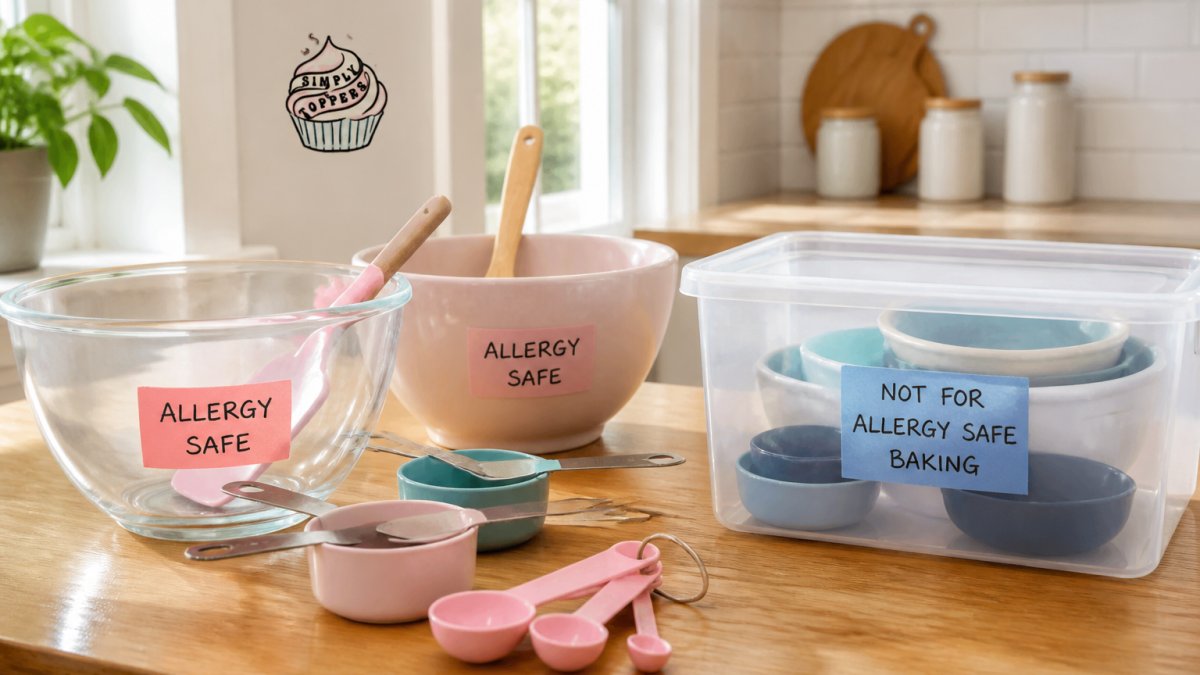
Tools That Cannot Be Shared Safely
Some tools trap gluten no matter how well you wash them. These need their own set:
- Wooden spoons and wooden boards
- Sieves and flour sifters
- Non-stick baking trays with scratches
- Rolling pins
- Mixing bowls with rough interiors
- Measuring cups for dry ingredients
- Whisks with wire heads
- Pastry brushes
Silicone and stainless steel clean up better. Even so, keeping a separate set removes all doubt.
How to Store and Label Your Allergy-Safe Kit
Storage matters as much as separation. A closed container keeps dust off your safe tools.
Try this simple system:
- Choose one sealable box or drawer for gluten-free tools only
- Mark every handle with a coloured sticker or tape
- Store the box away from loose flour and open packets
- Wash safe tools first, before any gluten baking
- Replace scratched or cracked items straight away
- Keep a spare sieve and whisk so you're never tempted to share
Cleaning Kitchen Surfaces for Gluten-Free Baking
Cleaning kitchen surfaces for gluten-free baking means removing gluten, not just wiping over it. Hot soapy water and a fresh cloth do the job better than a quick spray.
Work top to bottom. Start with shelves and splashbacks, then move to worktops, then the floor.
Follow this order:
- Clear the worktop completely
- Wipe with hot soapy water using a clean cloth
- Rinse with a second clean cloth
- Dry with a fresh towel
- Repeat before every gluten-free bake
Pay extra attention to corners, seams, and the edges where worktops meet the wall. Crumbs collect there.
If you've just baked with regular flour, give the kitchen time to settle. Flour dust can hang in the air for a while. A quick wipe straight after won't catch what's still floating.
Checking Food Labels for Allergens Before You Bake
Checking food labels for allergens is the step most home bakers rush. It's also the one that catches people out.
In the UK, the 14 major allergens must be emphasised on packaging. That makes label reading easier, but only if you know what to look for.
The 14 Allergens You Need to Track
The Food Standards Agency list of 14 allergens covers the ingredients you must watch for. They are:
- Celery
- Cereals containing gluten
- Crustaceans
- Eggs
- Fish
- Lupin
- Milk
- Molluscs
- Mustard
- Nuts
- Peanuts
- Sesame
- Soya
- Sulphur dioxide and sulphites
If you bake for someone with a specific allergy, check for that one first. Then scan the rest of the label for anything unexpected.
Reading 'May Contain' Statements
"May contain" means the maker can't rule out traces. It's a warning, not a guarantee of safety.
Here's how to handle it:
| Label wording | What it means | What to do |
|---|---|---|
| "May contain traces of nuts" | Possible cross-contact in the factory | Avoid if the allergy is severe |
| "Made in a factory that handles milk" | Shared production lines | Check with the maker first |
| "Free from gluten" | Meets legal gluten-free standard | Safe for most coeliac bakers |
| "No gluten ingredients" | No gluten added, but not certified | Treat with caution |
When in doubt, contact the manufacturer. Most are happy to explain their process.
Choosing Allergen-Friendly Cake Decorations
Decorations are the last thing added and the easiest thing to overlook. A safe cake can be undone by a topper that contains milk, gluten, or nuts.
At Simply Toppers, our sugar paste toppers are 100% vegan, vegetarian, and free from dairy and gluten. We've been making them by hand since 2013, and we know how much that matters when you're baking for a child with allergies.
A few things to check before you buy:
- Does the maker list every allergen clearly?
- Are the decorations made in a nut-free environment?
- Is the sugar paste free from dairy and gluten?
- Can the maker confirm their process if you ask?
Our award-winning designs are made to be inclusive. That means everyone at the party can enjoy the same cake, without anyone having to skip the decoration.
Common Mistakes That Break Cross Contamination Free Baking
Even careful bakers slip up. These are the mistakes we see most often, and how to avoid them.
- Sharing the butter dish. Crumbs from regular toast transfer straight onto your safe bake. Use a separate tub.
- Reusing the same cloth. A cloth that's wiped gluten will spread it. Use fresh cloths and wash them hot.
- Skipping the sieve. Gluten-free flour still needs sifting, but only with a dedicated sieve.
- Trusting "gluten-free" alone. Check the full label, not just the front of the pack.
- Baking both at once. Flour dust travels. Bake gluten-free first, or on a different day.
- Forgetting hands and aprons. Wash hands and change aprons between bakes.
Conclusion: Building Habits That Keep Every Bake Safe
Cross contamination free baking comes down to routine, not perfection. Separate your tools, clean properly, read every label, and choose decorations you can trust.
If you're baking for a party, our handmade toppers take one worry off your list. Every design is vegan, gluten-free, and dairy-free, and each one is made by hand. You can browse our range or use our Quick Order Form to get exactly what you need for the occasion.
Get started with Simply Toppers and decorate your next cake with confidence, knowing everyone at the table can join in.
Frequently Asked Questions
How do you prevent cross-contamination when baking?
Preventing cross-contamination starts with separation. Keep dedicated utensils, bowls and baking tins for allergen-free baking, and never share them with regular flour products. Clean all work surfaces with hot soapy water before you begin, and wash your hands thoroughly. Store allergen-free ingredients in sealed containers above or away from gluten-containing flours, because airborne flour dust can settle on open packaging. If you bake regularly for someone with a gluten allergy, treat your allergen-free kit as a completely separate setup that never touches regular baking equipment.
Can you use the same oven for gluten-free and regular baking?
Yes, you can use the same oven, but you need to take precautions. Gluten does not survive high heat in a way that contaminates food through the air, but residue on oven racks, baking trays or pizza stones can transfer. Line trays with fresh baking parchment every time, and avoid placing gluten-free bakes directly on a rack that has had gluten-containing items on it. If you bake gluten-free regularly, keeping a separate set of baking trays and tins is the simplest way to remove any doubt.
How can you check whether cake decorations are suitable for someone with an allergy?
Check the packaging for a full allergen statement, not just a 'free from' claim. In the UK, the 14 major allergens must be listed in bold or highlighted on the ingredients list. Look for clear statements about gluten, dairy, nuts and eggs. If a product says 'may contain' an allergen, treat it as unsuitable for someone with a severe allergy. For handmade decorations, ask the maker directly about their kitchen practices and whether they handle allergens on the same premises. Reputable makers will answer clearly and without hesitation.
Which baking tools should be kept separate for allergy-friendly baking?
The tools most prone to trapping allergens are wooden spoons, rolling pins, silicone spatulas, non-stick baking trays and sieves. Wood and silicone are porous and can hold residue even after washing. Keep a separate set of these items for allergen-free baking and store them in a clearly labelled container. Metal bowls, stainless steel whisks and glass measuring jugs are easier to clean thoroughly, but if you bake allergen-free often, a dedicated set removes the risk entirely. Colour-coding your kit with stickers or bands makes it easy for everyone in the kitchen to identify.