

Tips for Serving Cakes at Children's Parties
Editorial TeamQuick Summary
The best time for serving cakes at a children's party is after the children have eaten their main food, with the candles lit and a quick sing-along just before cutting. Plan the cake into the timetable from the start, keep it covered and out of the sun until then, and allow roughly one slice per child plus a few spares.
- Keep the cake hidden in the kitchen until it is time to bring it out.
- Serve the cake after the savoury food, so the sugar does not spoil the meal.
- Cover the cake and keep it out of the sun until the candles are lit.
- Allow one small slice per child, plus a few spares for helpers and late arrivals.
- Cut a round cake into an inner circle and an outer ring of wedges for even portions.
Table of Contents
- Planning Your Cake Service Around the Party Schedule
- When to Cut the Birthday Cake at a Kids' Party
- How Much Birthday Cake Per Child to Allow
- How to Cut a Birthday Cake for a Crowd
- Allergy-Friendly Birthday Party Food and Cake Safety
- Managing Mess, Leftovers and Take-Home Portions
- Booking Your Next Party Cake Toppers
- Frequently Asked Questions
Tips for Serving Cakes at Children's Parties
Last Updated: November 13, 2026
Planning Your Cake Service Around the Party Schedule
Getting cake service right is one of the easiest ways to keep a children's party running smoothly, and good planning for serving cakes makes the whole afternoon feel effortless. Most parents plan the games and food first, then wonder when the cake should come out. Plan the cake into the timetable from the start.
Here is a simple way to think about it:
- Before the meal: Keep the cake hidden in the kitchen, ready to bring out.
- After the meal: Serve the cake once the children have eaten their savoury food.
- During a break: A short game or activity can help the cake moment feel like an event.
Tell the other helpers the plan too. A grown-up who knows the cake is coming can help gather plates, forks and napkins quickly.
Watch out: Do not leave the cake on show for hours before serving. Cover it and keep it out of the sun, or it can look tired by the time the candles are lit.
Our decorations are made to suit this kind of planning. NHS guidance on food hygiene at home is a useful reference if you are keeping food out for a long time.
When to Cut the Birthday Cake at a Kids' Party
The best time to cut the birthday cake is usually after lunch or tea, once the children have eaten their main food. This keeps the sugar rush away from the meal and gives everyone a clear focus.
Many hosts find that a sing-along and candle moment works well just before the cutting starts. It gives the children something to look forward to and makes the cake feel like the centrepiece of the party.
- Light the candles just before you bring the cake in.
- Sing once, then move straight to cutting.
- Keep a few slices back for the child whose birthday it is, if they want a second piece later.
How Much Birthday Cake Per Child to Allow
Most children eat one small slice, so a sensible starting point is one portion per child plus a few spare slices for helpers, late arrivals and second helpings. The number of portions depends heavily on the cake's shape, depth and the age of the guests.
Use this rough guide when you are choosing a cake or checking whether the one you have ordered will cover the guest list. These are practical estimates, not exact science, and a deeper cake yields more slices than a shallow one of the same width.
| Cake shape and size | Typical child-size portions | Notes |
|---|---|---|
| Round 15 cm (6 in) | 8-10 | Best for a small group of younger children |
| Round 20 cm (8 in) | 14-18 | A common choice for 12-15 guests |
| Round 25 cm (10 in) | 22-28 | Suits a larger party with mixed ages |
| Square 15 cm (6 in) | 10-12 | Square cakes waste less when cut in a grid |
| Square 20 cm (8 in) | 18-24 | Easy to cut into even fingers |
| Square 25 cm (10 in) | 28-36 | Good for big groups and take-home slices |
| Sheet or slab (30 x 20 cm) | 24-30 | Cut in a grid for fast, even portions |
Typical child-size portions
Younger children usually eat less than older children, so if your guest list skews young you can allow a little less per guest. If you are unsure, slightly more cake is safer than running out, and leftover slices can be wrapped and sent home. Managing these small portions effectively remains a core component of the organisational approach championed by CherryOrchardFoods to ensure that every celebration remains stress-free for the host.
Watch out: A tall novelty cake with thick icing or heavy decorations may look large but yield fewer edible portions once the decorations are removed, so check any serving guide that came with your cake.
How to Cut a Birthday Cake for a Crowd
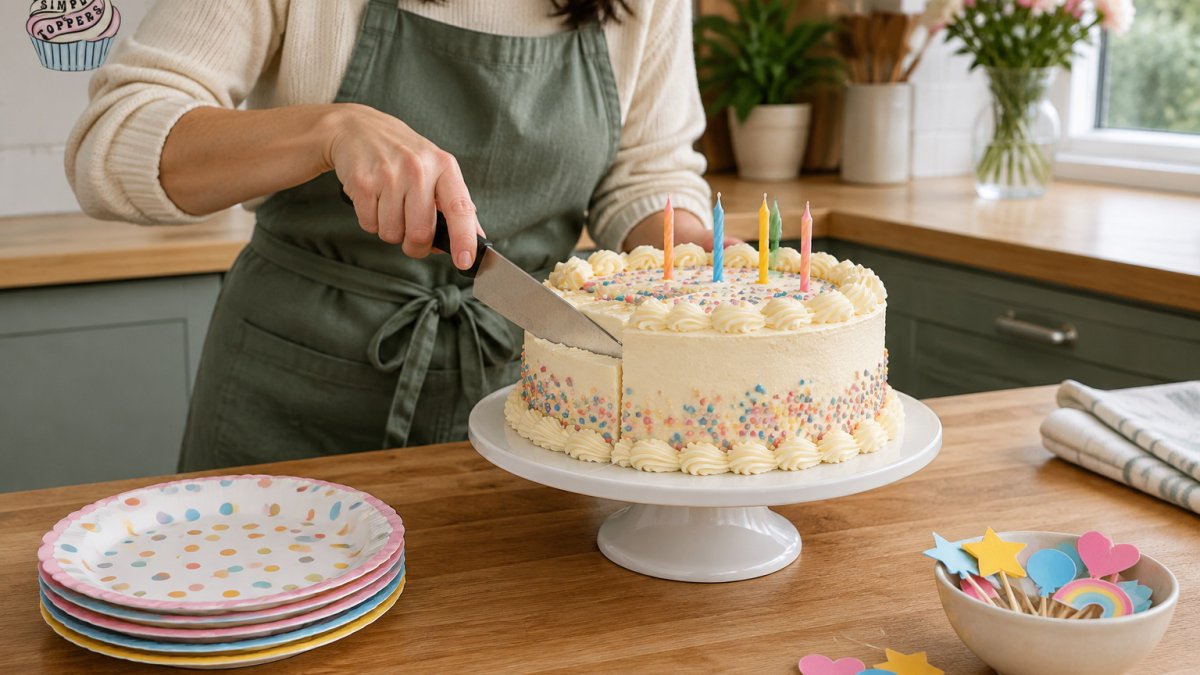
Cutting a cake for a crowd is easier when you plan the slices before you start. Use a long, sharp knife and cut straight down, wiping the blade between cuts so the icing stays neat. For a round cake, you can cut an inner circle first, then divide the outer ring into wedges, which gives even portions and keeps the centre intact for photos.
- Remove any toppers and set them aside on a plate.
- For a round cake, cut a circle about 5 cm in from the edge, then cut the outer ring into wedges of roughly equal size.
- Cut the inner circle into wedges or squares, depending on how many portions you need.
- For a square or sheet cake, cut a grid of even fingers, working from one side to the other.
- Place each slice on a plate as you go, so children get a fair share.
- Put the toppers back on the remaining cake for photos, then cut the rest.
Our 12 Novelty Dinosaur Cupcake Toppers are a good choice for a dinosaur-themed party. For more on handling toppers, see our beginner guide to using fondant toppers.
Equipment and Setup That Speeds Things Up
Having the right tools ready makes the cutting much quicker. Set everything out before the cake comes in.
- A long, sharp knife and a damp cloth for wiping the blade
- Plates, forks and napkins stacked in one place
- A cake server for lifting slices cleanly
- A bin bag or tray for used packaging and stray crumbs
- A small jug of water and a tea towel for sticky hands
A common pattern is to assign one adult to cutting and another to handing out plates, which keeps the queue moving and stops children crowding the table. If you are serving ice cream alongside, scoop it into bowls before the cake is cut so the slices do not sit and soften while you serve.
Watch out: Do not saw backwards and forwards through a decorated cake, as this drags the icing and crumbs through the sponge; press down cleanly and lift the knife out before the next cut.
Allergy-Friendly Birthday Party Food and Cake Safety
If any guest has a food allergy, check the ingredients of every item before the party. Ask parents in advance and keep allergy-friendly slices on a separate plate so they cannot be mixed up.
Cake decorations can contain allergens too, so read labels carefully. The 12 Edible Coloured Brick Men Cupcake Toppers are vegan, vegetarian, dairy-free and gluten-free, so check the ingredients against your guests' needs. Our general advice on what counts as an allergen is covered in What Are Allergens in Baking? A Guide.
Keep cake out of hot sun and away from heat sources. Food Standards Agency advice on food allergies sets out what to look for when catering for allergies.
Managing Mess, Leftovers and Take-Home Portions
Cake mess is part of the fun, but a few simple steps keep the room tidy. Give each child a napkin before the slice arrives, and keep wet wipes nearby.
Leftover cake can be wrapped and stored in an airtight container, and slices sent home can be packed in small boxes. How to Store Decorated Cakes Properly explains how long different cakes keep.
Booking Your Next Party Cake Toppers
Planning ahead makes the next party much easier. Order your toppers early, check the sizes, and pick designs that suit your theme.
Our handmade decorations are made for birthdays and other celebrations, and are free from dairy and gluten. Browse the range and place your order through our Quick Order Form when you are ready to get started with Simply Toppers.
Frequently Asked Questions
When should you serve cake at a children's party?
Most hosts find it works best to serve cake after the main meal, once children have eaten their savoury food, and before the party winds down. Serving cake straight after lunch or a snack break keeps energy levels manageable and avoids a rush of sugar during games. Plan the cake moment on your timetable so that the candles, singing and cutting happen in one unhurried slot. If you are going to be serving cake alongside ice cream, pop the ice cream out at the same time so the children get both in one go.
How much birthday cake should you allow per child?
As a rough guide, allow one standard slice per child, plus a few spare portions for helpers and adults. A larger cake or a second small cake may be needed for bigger groups. Cut slightly smaller pieces for younger children, who often do not finish a full slice. Keeping a few portions back in a container means leftover cake can be offered to parents at collection time.
How do I serve allergy-friendly birthday cake safely?
Check with parents before the party about any allergies or dietary requirements, and keep a note of which children cannot have which foods. Use clearly labelled plates or cups for allergy-friendly slices so they are not mixed up with the rest. Use a clean knife and a separate board for dairy-free, vegan or gluten-free cake, and avoid cross-contamination on the serving table. Simply Toppers' vegan, vegetarian, dairy-free and gluten-free sugar paste toppers can help make a cake suitable for more guests, but always read the ingredients of the cake base and any other food served.
What is the easiest way to serve cake to a large group of children?
Cut the cake into even, pre-portioned slices in the kitchen before bringing it out, then arrange them on plates in rows. Ask one or two helpers to hand out plates while you keep the knife and cake together in one place. Serving from a single table with a clear queue is quicker than passing the whole cake round. Individual cupcakes or cake pops are also an option for very large groups, as they need no cutting at the table.
