

Best Cake Decorating Tools for Beginners: A Review
Editorial TeamTable of Contents
- What Cake Decorating Tools Do Beginners Actually Need?
- The Best Cake Decorating Kit for Beginners: What to Look For
- Best Piping Tips for Beginners: Start Simple
- How to Smooth Buttercream on a Cake
- Your Complete Cake Decorating Supplies List
- Cake Decorating Tools: Common Mistakes to Avoid
- Conclusion: Choosing the Right Tools for Your Kitchen
- Frequently Asked Questions
What Cake Decorating Tools Do Beginners Actually Need?
Last Updated: October 19, 2026
A cake decorating tools starter set is smaller than most beginners expect: a good turntable, two or three piping tips, a palette knife, a bench scraper and a few piping bags will carry you through your first year of bakes. At Simply Toppers, we have watched home bakers since 2013 buy far too much before their first cake and then give up. The truth is simpler than the shops suggest. You need a handful of pieces that work properly, not a cupboard full of gadgets you will use once.
Below, we break down what genuinely earns its place on the counter, what you can skip, and how to choose between the options on the shelf. The advice follows the same practical approach we take when making our own handmade edible decorations: keep it simple, keep it safe for everyone at the table, and let the finish do the talking.
The Best Cake Decorating Kit for Beginners: What to Look For
The best cake decorating kit for beginners is one built around stability, grip and easy cleaning rather than the number of pieces in the box. A kit with twenty items usually means twenty flimsy items. Judge each piece on its own merits and ignore the box photo.
Here is how we would assess any starter kit before buying:
- Turntable: should spin smoothly with a cake on top and have a non-slip base. Plastic is fine; a wobbly one is not.
- Piping bags: reusable fabric bags survive years; disposable ones are convenient but split under thick buttercream.
- Nozzles: look for stainless steel with a seamless join. Cheap two-part nozzles trap icing and rust.
- Palette knife: a thin, flexible blade about 20cm long gives you control on curved sides.
- Bench scraper: a straight metal edge, at least 15cm tall, for smoothing sides in one pass.
- Storage: a small case keeps nozzles together so you are not hunting through drawers mid-bake.
The Food Standards Agency guidance on food contact materials is worth a read if you are buying budget tools, since anything touching food should be fit for purpose. A kit that feels solid in the hand almost always outperforms one that looks impressive in the box.
Best Piping Tips for Beginners: Start Simple
Three piping tips cover almost everything a beginner needs: a large star nozzle, a round nozzle and a petal or drop-flower nozzle. That is the whole list. Everything else is a variation you can add later once your hand is steadier.
The large star tip, usually around 1cm across the opening, makes rosettes, swirls and simple borders. The round tip pipes dots, writing and outlines. A petal nozzle gives you easy flowers with a single squeeze and lift. Start with those and learn what each one does before adding to the collection.
A common mistake is buying a set of tiny nozzles because they look delicate. Small openings clog with buttercream and are far harder to control. Go larger than you think you need.
How to Smooth Buttercream on a Cake
Smoothing buttercream is a two-tool job: a palette knife to get the icing roughly in place, then a bench scraper held at a slight angle to finish the sides. The trick is working in stages and chilling between them, not trying to get a perfect finish in one pass.
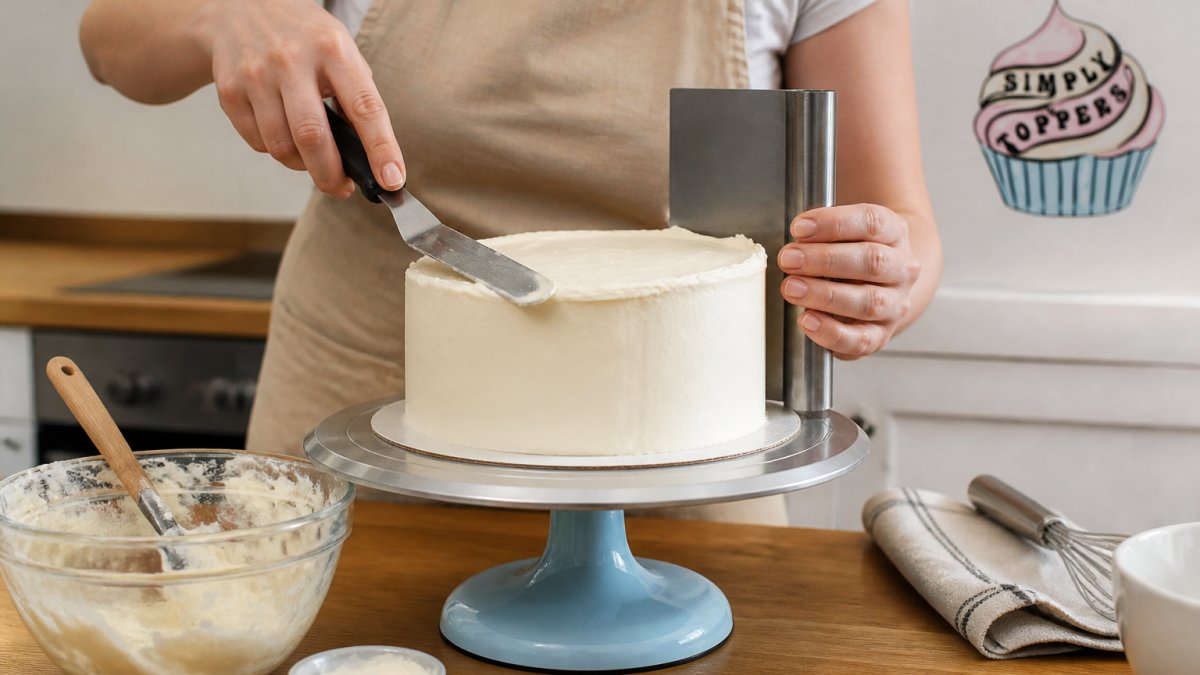
Work through it like this:
- Crumb coat first. A thin layer of buttercream to lock the crumbs in, then chill for 20 to 30 minutes.
- Apply the main coat generously. Pile it on top and let the palette knife push it over the edges.
- Scrape the sides. Hold the bench scraper upright against the cake and turn the turntable slowly, letting the excess fall away.
- Chill and repeat. A second pass on a cold cake gives you the clean finish.
- Finish the top. Draw the palette knife from the outside in, wiping the blade between strokes.
Patience beats pressure here. Rushing the chill is the single most common reason a smooth finish turns streaky.
Your Complete Cake Decorating Supplies List
A full cake decorating supplies list for a beginner fits on one side of a notepad. Beyond the core tools, add a few consumables and you are set for most celebration cakes.
| Item | Why You Need It | Beginner Priority |
|---|---|---|
| Turntable | Even smoothing and piping | Essential |
| Palette knife | Applying and shaping icing | Essential |
| Bench scraper | Clean sides in one pass | Essential |
| Star, round, petal nozzles | Covers most designs | Essential |
| Reusable piping bags | Durable, better grip | Essential |
| Offset spatula | Lifting and spreading | Useful |
| Cake leveller | Even layers | Useful |
| Piping bag clips | Stop icing escaping | Nice to have |
| Edible toppers | Instant finish, no piping skill | Useful |
That last row matters more than beginners expect. A beautifully smooth cake still needs a focal point, and handmade edible decorations do the job without any piping confidence at all. Our own sugar paste toppers are 100% edible, suitable for vegans and vegetarians, and free from dairy and gluten, so a cake can look celebration-ready and still suit every guest at the table. We have won Bronze and Gold at the Free From Food Awards 2025, which matters if you are baking for someone with allergies.
Cake Decorating Tools: Common Mistakes to Avoid
The most expensive mistake beginners make is buying a huge kit before learning what they actually use. The second is skimping on the two tools that do the most work: the turntable and the scraper. A wobbly turntable makes every finish look uneven, no matter how good your icing is.
Other traps worth sidestepping:
- Overfilling piping bags. Fill to two-thirds at most, or the bag bursts at the seam.
- Using the wrong buttercream consistency. Too stiff and it tears; too soft and it slumps. Adjust with a splash of milk or a spoon of icing sugar.
- Skipping the crumb coat. It is not optional if you want a clean finish.
- Buying novelty nozzles first. Learn the basics before you branch out.
- Ignoring dietary needs. If you are baking for a celebration with allergies, plan your decorations as carefully as your sponge. The NHS advice on food allergies is a useful starting point for checking what to watch for.
Conclusion: Choosing the Right Tools for Your Kitchen
Building a cake decorating tools collection is a slow, sensible process, not a single shopping spree. Start with the five essentials, learn how they behave, and add only what you find yourself reaching for. Your cakes will improve faster than your cupboard fills.
When you are ready to finish a bake without fuss, Simply Toppers makes handmade edible decorations that suit vegans, vegetarians and anyone avoiding dairy or gluten, with award-winning designs for birthdays, baby showers and seasonal celebrations. Browse our range or use our Quick Order Form to find the perfect topper for your next cake.
Frequently Asked Questions
What cake decorating tools does a beginner need?
You can start with a small set of essentials: an offset palette knife, a bench scraper, a turntable, a piping bag with two or three basic nozzles, and a set of measuring spoons. These cake decorating tools cover levelling, filling, crumb coating, and simple piping. Add a cake leveller if you want even layers. You do not need a full professional kit on day one, and buying a few good-quality items beats a large set of flimsy ones.
Which piping tips should beginners start with?
Begin with a round tip for dots and outlines, a star tip for rosettes and swirls, and a petal tip for simple ruffles. These three cover most beginner designs and let you practise pressure control without juggling a dozen nozzles. Look for seamless stainless steel tips, which hold their shape better than plastic. Once your hand is steady with these, add a leaf tip or a grass tip for extra detail.
Do beginners need a cake turntable?
A turntable is one of the most useful cake decorating tools you can buy. It lets you rotate the cake while keeping your palette knife steady, which makes smoothing buttercream far easier and gives you an even finish on the sides. You can work without one, but you will spend longer and the result is rarely as neat. A basic plastic turntable is affordable and does the job well for home bakers.
Can you decorate a cake without specialist tools?
Yes. A butter knife, a flat spatula, a freezer bag with the corner snipped off, and a steady hand can produce a simple, attractive cake. Specialist cake decorating tools mainly save time and improve consistency, so they are worth adding as you go. Start with a palette knife and a piping bag, then build your cake decorating supplies list as your confidence grows and your designs get more ambitious.