

How to Arrange Sugar Flowers on Cakes Creatively
Editorial TeamQuick Summary
The most effective way to arrange sugar flowers on a cake is to pick one focal point and build around it, using a mix of stem lengths so the design looks naturally grown rather than placed. Choose a style that suits the occasion, whether naturalistic, asymmetrical or symmetrical, and leave breathing space so the cake still looks like a cake.
- Pick one focal point before placing any other flowers.
- Spread smaller flowers outwards rather than evenly across the top.
- Mix short, medium and long stems for a natural look.
- Use a flower pick for any flower heavier than a teaspoon of icing.
- Remove all picks and wires before the cake is cut and served.
Table of Contents
- Why Arrangement Matters as Much as the Flowers Themselves
- Tools and Equipment You'll Need Before You Start
- Choosing a Flower Arrangement Style for Your Cake
- How to Attach Sugar Flowers to Cake Without Damage
- Creative Layouts: Varying Stem Lengths and Creating a Cascade
- Vegan and Gluten-Free Sugar Flower Options for Mixed Guest Lists
- Planning Your Next Flower-Covered Celebration Cake
- Frequently Asked Questions
Sugar flowers can transform a plain cake into something that looks like it came from a florist's window. Yet most of the difference between a flat, awkward topper and a striking, natural-looking arrangement comes down to how the flowers are placed, not how they were made. At Simply Toppers, we've been making handmade sugar paste toppers since 2013, and a few simple arrangement choices can change the whole look of a bake. This guide walks you through creative ways to arrange sugar flowers on cakes, from choosing your tools to placing flowers on a tiered cake.
Sugar flowers are edible decorations, typically made from sugar paste and shaped by hand. Arranged well, they add depth, colour and movement. Arranged poorly, they can look crowded or stuck on as an afterthought.
Why Arrangement Matters as Much as the Flowers Themselves
Two cakes can use identical flowers and look completely different. The difference is usually composition: where the eye lands first, how the flowers lead the eye around the cake, and whether there is enough breathing space between them.
A common mistake is piling every flower into one spot. Instead, think about a focal point, one larger bloom or cluster, supported by smaller flowers and foliage that trail away from it. This creates balance without making the cake look overloaded.
- Pick one focal point before you place anything else
- Spread smaller flowers outwards, not evenly across the top
- Leave some space so the cake still looks like a cake
Tools and Equipment You'll Need Before You Start
Having the right tools on hand makes the process smoother and protects your flowers from damage. You don't need a professional kit, but a few basics help a lot.
- Floral tape for wrapping wire stems
- Flower picks or posy picks to hold flowers at the right height
- Food-safe wire in a suitable gauge for holding flowers
- A small paintbrush and cooled boiled water or edible glue for attaching flowers
- Tweezers for positioning small flowers and petals
- A turntable so you can work evenly around the cake
Work on a clean, flat surface and keep your flowers covered until you need them, so they don't dry out or collect dust.
Choosing a Flower Arrangement Style for Your Cake
Before you touch a flower, decide on the overall look. Three popular styles work well for most celebration cakes:
- Naturalistic: Flowers placed loosely, as though they grew there. Vary the angles and avoid perfect rows.
- Asymmetrical: A heavier cluster on one side, with lighter sprigs trailing the other way. This suits modern cakes.
- Symmetrical: Matching groups on each side. This suits formal occasions and classic designs.
Choose the style that fits the event. A wedding cake may call for soft, naturalistic sprays, while a birthday cake can handle bolder, asymmetrical clusters.
How to Attach Sugar Flowers to Cake Without Damage
Attaching flowers is where most damage happens, so take your time here. The goal is a secure hold without cracking petals or smearing the surface. Most practitioners find that the single biggest cause of damage is not the attachment method itself but the temperature and firmness of the cake surface at the moment of placement.
Start with a clean, dry cake surface or a lightly crusted buttercream or ganache. A thin layer of edible glue or a dab of cooled boiled water usually holds small flowers well. For heavier flowers, use a pick or wire. The key is to match the attachment method to the weight and size of the flower, not to use the same approach for every bloom.
Watch out: Pressing a flower too firmly into soft buttercream can crack the petals or sink the flower lower than you intended. Chill the cake briefly first if the surface is very soft. A common pattern is to work on a cake that has been out of the fridge for twenty to thirty minutes, so the surface is firm enough to hold a flower but not so cold that condensation forms and loosens the glue.
Choosing the Right Attachment Method for the Flower's Weight
Small, lightweight flowers such as tiny blossoms or single petals can be attached directly with edible glue or a dab of cooled boiled water. Medium flowers benefit from a short wire stem inserted into the cake, which gives you more control over angle and height. Larger, heavier blooms need a flower pick or posy pick so the weight is carried by the pick rather than by the buttercream.
A useful rule of thumb is that if the flower feels heavier than a teaspoon of icing, it needs a pick or a wire. For wired flowers, always use food-safe wire and wrap the stem in floral tape so no metal touches the cake. This is not just a hygiene point: unwrapped wire can react with the moisture in buttercream and leave a dark mark on the surface.
12 Mini Vegan Rose Cupcake Toppers - Glittered Edible Garlands →
The Humidity Factor
Sugar paste flowers are sensitive to moisture in the air. On a humid day, the surface of a sugar flower can become slightly tacky, which makes it harder to handle and more likely to stick to your fingers or to the cake in the wrong position. Working in a cool, dry room and keeping unused flowers in an airtight container until placement can help. If the kitchen is steamy from boiling or dishwashing, move the cake to another room before you start attaching flowers.
Removing Flowers Safely Before Serving
One of the most overlooked parts of attachment is planning for removal. If you have used picks or wires, make a note of where they are so you can take them out before the cake is cut. Non-edible supports should never reach a guest's plate. Before serving, lift each flower gently by the petal base rather than the stem, and check that no wire or pick remains in the cake. A quick count of flowers placed against flowers removed is a simple way to confirm nothing has been left behind.
Alternative Attachment Methods
Paper-wrapped wires are a good option for flowers that need a longer stem, because the paper creates a barrier between the wire and the cake. Chocolate glue, made by melting a little chocolate and using it as a dab, works well for attaching flowers to a chocolate ganache surface and sets firmer than edible glue. For a more eco-friendly approach, some bakers use a small piece of dried pasta as a hidden support for lightweight flowers, though this is best reserved for cakes that will be served the same day.
Creative Layouts: Varying Stem Lengths and Creating a Cascade
Stem length is one of the easiest ways to add natural depth. Mixing short, medium and long stems makes the arrangement look as though it has grown rather than been placed.
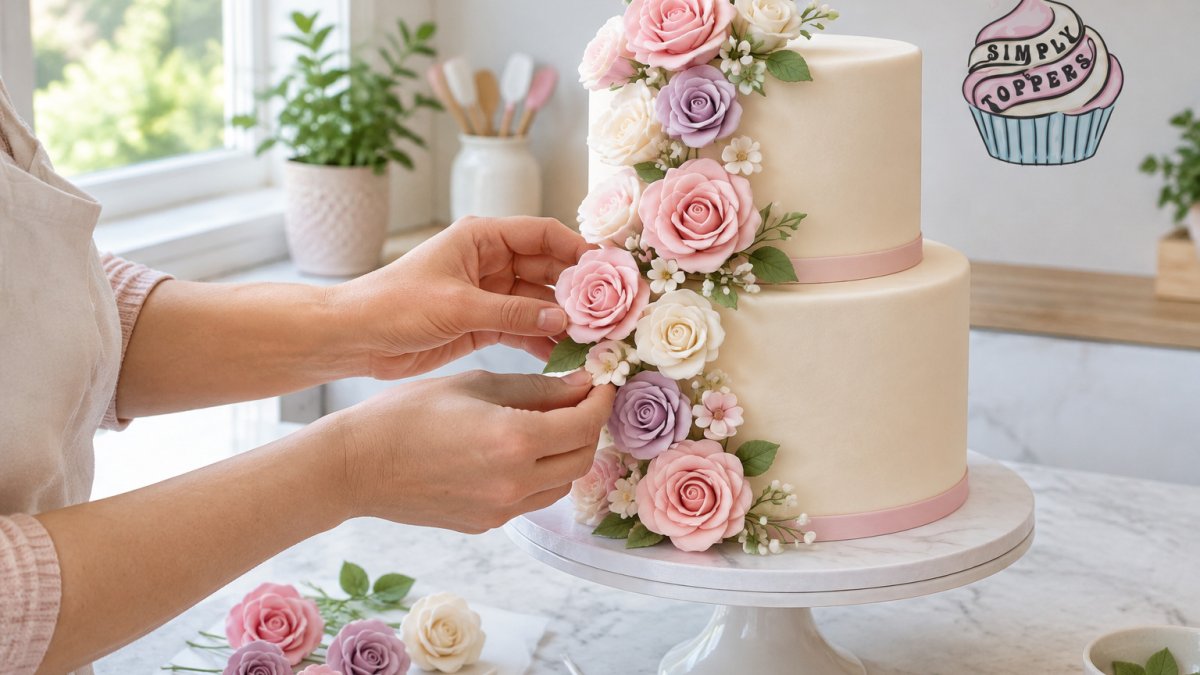
To create a cascade, start high at one point and let the flowers trail down the side of the cake. Use longer stems at the top and shorter ones lower down so the flowers follow a gentle curve.
- Use three stem lengths for a natural look
- Keep the cascade on one side for a bold, modern effect
- Let a few stray blooms drop lower than the rest for movement, or start with ready-made large glittered pastel flower decorations to build your cascade around.
Vegan and Gluten-Free Sugar Flower Options for Mixed Guest Lists
If your guest list includes vegan or gluten-free guests, choose decorations made to suit those needs. Our guide to coeliac-safe toppers shows which ones are safe, vegan and gluten free. Our handmade sugar paste toppers are 100% vegan, vegetarian, dairy-free and gluten-free, so they suit many dietary requirements.
Our 12 Mini Vegan Rose Cupcake Toppers at £6.50 suit cupcake displays, while our Set of 4 Glittered Rose Wedding Cake Toppers at £6.25 work well for celebration cakes.


Always check ingredient labels for the other decorations and the cake itself, since allergens can come from any part of a bake. If gluten-free baking is new to you, our first steps guide covers the basics.
Planning Your Next Flower-Covered Celebration Cake
Good arrangement is mostly about planning: choose a style, set a focal point, and build the design in layers. Start simple, practise on a spare cupcake, and work up to a full cake once you're comfortable with the placement.
When you're ready to add toppers to your next celebration bake, our range of 4 Coloured Glittered Rose Garland Cake Toppers at £5.99 and 4 Glittered Rose Cake Toppers with a Large Centre Rose at £10.95 offer a ready-made starting point for your arrangement. Browse the full collection and find the right toppers for your next celebration.

Frequently Asked Questions
How do you secure sugar flowers on a cake?
Sugar flowers stay in place best when they are anchored rather than simply pressed onto the surface. Insert a flower pick or posy pick into the stem, then push it gently into the sponge or buttercream.
Can you put sugar flowers directly onto buttercream?
Yes, you can place sugar flowers directly onto buttercream, but they need a firm base to stay put. Buttercream is soft, so heavier blooms can sink or tilt over a few hours.
Are sugar flowers suitable for vegan and gluten-free cakes?
Sugar flowers made from vegan, vegetarian, dairy-free and gluten-free sugar paste can suit many guests. Our Simply Toppers designs, such as the 12 Mini Vegan Rose Cupcake Toppers at £6.50, are made from sugar paste that is free from dairy and gluten. Always check the ingredients listing on any product if a guest has a severe allergy, and keep decorations away from foods where cross-contact could be a concern.
