

How to Store Sugar Decorations: A Simple Guide
Editorial TeamTable of Contents
- Why Proper Storage Matters for Sugar Decorations
- What You'll Need to Store Sugar Decorations Safely
- Step-by-Step: How to Store Sugar Decorations for Freshness
- How Long Do Sugar Decorations Last?
- Do Edible Toppers Melt Fast? Managing Heat and Humidity
- Common Storage Mistakes and Troubleshooting
- Conclusion: Keep Your Toppers Party-Ready
- Frequently Asked Questions
Last Updated: September 4, 2026
Why Proper Storage Matters for Sugar Decorations
Sugar decorations are an investment in your cake's wow factor, and nothing deflates a party plan faster than a topper that has gone soft, cracked, or lost its colour. How you store them before the celebration determines whether they look crisp and vibrant or tired and damaged.
At Simply Toppers, we have made and packaged handmade edible decorations since 2013, so we know exactly what happens when these delicate pieces meet the wrong conditions. Proper storage is simple once you understand the two enemies of sugar art: moisture and heat.
Below, we walk you through the containers, environment, and timelines that keep your decorations party-ready.
What You'll Need to Store Sugar Decorations Safely
Before you pack anything away, gather a few basic supplies, most you will already have in your kitchen.
- Airtight containers that are food-safe and large enough to hold your toppers without crushing them
- Kitchen paper or a clean, dry cloth for padding and moisture control
- A cool, dark cupboard or pantry away from heat sources
- Optional: silica gel packets to absorb excess moisture in humid conditions
- Cardboard boxes for extra protection if you are storing multiple layers or large pieces
Best Containers for Sugar Paste Decorations
The best containers for sugar paste decorations are rigid, airtight, and food-safe. Plastic tubs with snug-fitting lids work well for most home bakers, as do glass containers with rubber seals. The container needs to protect the decoration from physical damage and from sudden changes in humidity.
Avoid anything that lets air circulate freely. Paper bags, open trays, and loosely covered bowls leave your decorations exposed to the kitchen's fluctuating moisture levels. A common mistake is storing fondant pieces in the fridge, where condensation forms when the container warms up, making decorations sticky or soft.
Step-by-Step: How to Store Sugar Decorations for Freshness
Follow this simple process to keep your decorations in top condition from arrival until they sit on your finished cake.
- Let freshly made or freshly unpacked decorations cure completely. Sugar paste needs time to dry and harden, and storing them too soon traps moisture inside. Give them at least 24 hours at room temperature in a dry spot.
- Place a sheet of kitchen paper at the bottom of your airtight container.
- Arrange the decorations inside so they do not touch each other. For delicate pieces like flowers or figures, add a layer of kitchen paper between items to prevent sticking and chipping.
- Seal the container completely and place it in a cool, dark cupboard or pantry. The ideal spot stays at a consistent room temperature, away from the oven, kettle, or direct sunlight.
- Check the container after a day or two. If you see condensation inside, remove the decorations briefly, swap in dry kitchen paper, and reseal.
- For humid weather, add a food-safe silica gel packet to the container to absorb excess moisture and help the decorations stay firm.
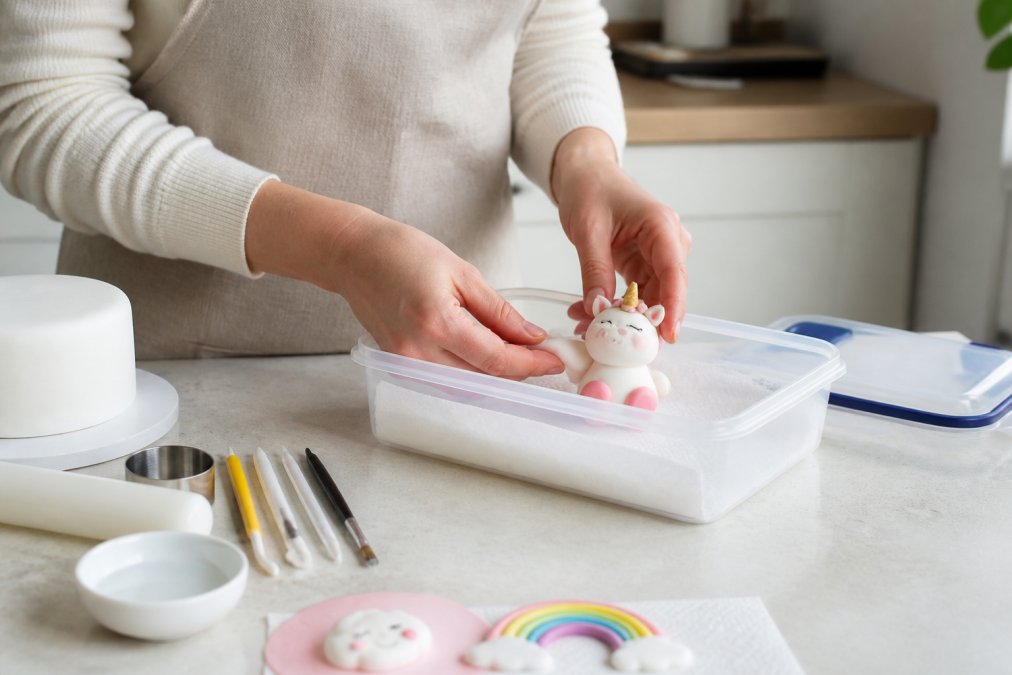
The key throughout is consistency. Sugar decorations prefer a stable environment, so avoid moving them between warm and cool spots repeatedly. Once they are sealed away, leave them alone until you need them.
How Long Do Sugar Decorations Last?
Sugar decorations last for several months when stored correctly, but the exact shelf life depends less on a fixed calendar date and more on the material's chemistry and the stability of your storage environment. Here is the practical breakdown for the four main sugar mediums.
Fondant (Sugar Paste)
Fondant is essentially a saturated sugar dough containing a small amount of water and fat, which keeps it pliable (peer-reviewed research). When stored correctly in an airtight container, it can last for three to six months. Fondant never fully hardens; it stays slightly supple. If the air is too dry, it will crack; if too humid, it will become sticky or 'sweat'. After that window, colours may dull and the surface can develop a slight bloom, even if the structure is intact.
Gum Paste
Gum paste contains a setting agent (usually CMC or tragacanth), which allows it to dry rock-hard, hence its use for delicate flowers and intricate filigree. Once cured, it is far less reactive to ambient moisture than fondant. In an airtight container with a silica gel packet, gum paste pieces can last up to twelve months without losing shape or colour. The main risk is physical breakage, not spoilage. Ensure it is fully cured (often 24-48 hours) before packing, or it can bend out of shape.
Isomalt
Isomalt is a sugar substitute boiled to a glass-like state. Unlike fondant or gum paste, it is hygroscopic, meaning it actively pulls moisture from the air, causing the surface to become tacky and eventually cloud over. Even in a sealed container, isomalt will degrade. You are looking at a shelf life of days to a few weeks at best, and only with a generous amount of silica gel. For this reason, isomalt pieces are almost always best made or purchased within a week of the event.
Spun Sugar
Spun sugar is made by flicking molten sugar into fine threads. Its massive surface area means it reacts with humidity almost instantly, so it is not a 'store it' medium. Plan to make or buy spun sugar on the day of the event, and keep it in a very dry, airtight box until assembly. Even a few hours in a humid kitchen will cause it to collapse.
The Real Variable: Your Environment
These durations assume a 'standard' UK climate, which is rarely standard. In a warm, damp August, knock a month off the fondant timeline; in a dry, centrally heated winter, add moisture control to prevent cracking. The best way to know if decorations are still good is the feel: a fondant figure that is firm and not tacky is fine, and a gum paste flower that snaps cleanly is fine. If it bends instead of snapping, it has absorbed moisture and is past its best.
Does 'Best Before' Apply?
If you bought your decorations from a shop (like ours at Simply Toppers), check the packaging for a 'best before' date. This is a legal requirement for food items and a reliable baseline, but it assumes you store the item correctly. A decoration in a hot, sunny window will fail long before that date, while one in a cool, dark tin may last well beyond it. The date is a guide, not a guarantee. If you need a specific design that will arrive fresh and ready to store, our decorations are handmade and can be custom made or order to suit your celebration timeline.
| Material | Typical Shelf Life | Primary Failure Mode | Best Storage Method |
|---|---|---|---|
| Fondant | 3-6 months | Drying out / cracking or sticky surface | Airtight container, cool and dry |
| Gum paste | Up to 12 months | Physical breakage | Airtight container with silica gel |
| Isomalt | Days to weeks | Clouding / sticky surface | Sealed container, low humidity, silica gel |
| Spun sugar | Hours to days | Collapse / melting | Airtight box, use immediately |
Once a decoration has been placed on a frosted cake, the clock resets and speeds up. Moisture from the icing and cake will migrate into the decoration: fondant figures may soften and droop within a day, and gum paste flowers may lose their crisp edge. This is normal, it is part of the cake's life cycle. Plan to add decorations on the day of the event, or the day before at the absolute earliest.
Do Edible Toppers Melt Fast? Managing Heat and Humidity
Do edible toppers melt fast? Most sugar decorations do not melt in the way chocolate or buttercream do, but they do soften, droop, and lose their shape when exposed to heat and humidity. A fondant figure left in a warm room will slowly slump, and gum paste flowers can become limp and sticky.
In practice, any room that feels warm and humid to you will affect your decorations. Summer parties, warm kitchens, and cakes kept near radiators or in direct sunlight are the highest risk situations. The decorations will not vanish, but they will look tired and less defined.
To keep your toppers looking their best, add them to the cake as late as possible before serving. If the cake needs to sit out for a few hours, choose a spot away from windows and heat sources. For outdoor events in warm weather, keep the decorated cake indoors until serving time.
:::warning Do not refrigerate a cake with sugar decorations on it. Condensation forms as the cake warms up, and that moisture makes fondant and gum paste sticky or causes colours to bleed. Decorate after chilling, not before. ::: applying edible toppers.
Common Storage Mistakes and Troubleshooting
Even with the best intentions, things can go wrong. Most guides stop at prevention, but the real value is knowing how to rescue a decoration that has already started to fail. Here are the most common mistakes and how to fix them.
Mistake 1: Storing in the Fridge or Freezer
This is the biggest myth in sugar decoration care. The cold itself is not the enemy; condensation is. When you take a cold container out of the fridge, warm air hits the cold surface and water vapour condenses into liquid water, making decorations sticky, soft, or causing colours to bleed.
The rescue: If a refrigerated decoration feels tacky, remove it from the container and place it on a dry surface in a warm, airy room (not direct sunlight) for a few hours. The surface moisture will evaporate, and the decoration will often firm back up. This works best for fondant and gum paste. For isomalt, the clouding is usually permanent.
Mistake 2: Using Ventilated Containers
Sugar decorations need protection from humidity, not airflow. A ventilated container, like a wire rack or a box with holes, allows moisture to cycle in and out, causing repeated softening and re-hardening. Each cycle stresses the sugar structure, leading to micro-cracks and a dull, chalky appearance.
The rescue: If your decoration has developed a chalky, cracked surface, it is often still salvageable. For fondant, rub a tiny amount of solid vegetable shortening (like Trex or Cookeen) over the surface with your fingertip to rehydrate the outer layer and restore a slight sheen. For gum paste, the cracks are usually structural; patch them with a small amount of fresh gum paste and smooth with a damp brush.
Mistake 3: Exposing Decorations to Light
Direct sunlight or strong artificial light fades the colours on your decorations over time. This is a photochemical reaction, pigments in the food colouring break down under UV light. Over weeks, a vibrant red can become a washed-out pink.
The rescue: Fading is irreversible. The only fix is prevention. Store decorations in an opaque container or inside a cardboard box within your cupboard. If you notice fading before the event, you can sometimes 'refresh' the colour by painting a thin layer of gel colour mixed with clear alcohol (like vodka or gin) over the faded area. The alcohol evaporates quickly and leaves the colour behind.
Mistake 4: Ignoring the Climate
Standard advice assumes a 'normal' temperate climate. In a high-humidity area, or during a damp UK summer, the air is already saturated with moisture, so your airtight container is not enough. Conversely, in very dry, centrally heated conditions, decorations can become brittle and crack.
The rescue for humidity: Add food-safe silica gel packets to your container to absorb ambient moisture. Check them weekly, if they feel squishy or have changed colour (if using indicating gel), they are saturated and need drying out in a low oven (as per packet instructions) or replacing. You can also add a small handful of uncooked rice in a muslin bag, though silica gel is more effective.
The rescue for dryness: If your decorations are cracking because the air is too dry, add a source of moisture. A common trick is to place a slice of fresh bread or a damp (not wet) piece of kitchen paper outside the container but inside a larger sealed box. This creates a slightly more humid microclimate without directly wetting the decorations. Check after 24 hours, the decorations should soften slightly.
Mistake 5: Storing Decorations Too Soon
If you make your own fondant or gum paste decorations, storing them before they are fully cured is a common error. Trapped moisture inside the piece will slowly migrate to the surface, causing a sticky film or even mould in extreme cases.
The rescue: If you open a container and find a sticky, tacky decoration, it is not necessarily ruined. Place it on a dry surface in a warm, airy room for 12-24 hours to allow excess moisture to escape. If it firms up, you can re-store it. If it remains sticky after 48 hours, the piece is likely too moist internally and is best replaced.
A Final Note on Mould
While rare, mould can grow on sugar decorations stored in a warm, damp environment for weeks. Look for fuzzy spots that are white, green, or black. If you see mould, discard the decoration immediately, do not attempt to scrape it off, as the spores will have penetrated the sugar structure. This is why checking your containers weekly is so important.
Conclusion: Keep Your Toppers Party-Ready
Storing sugar decorations well comes down to three habits: use an airtight container, keep it in a cool and dry place, and check for condensation regularly. Master those, and your decorations will stay firm, colourful, and ready to impress.
Planning a celebration and want decorations that arrive in perfect condition? At Simply Toppers, our handmade sugar paste toppers are 100% vegan, vegetarian, and free from dairy and gluten, so everyone at your party can enjoy them. With award-winning designs and over a decade of experience, we make it easy to find the perfect finishing touch. Free From Food Awards 2025 winners recognised our quality, and we would love to help with your next bake. Scotland's Prestige Awards cake decorating category Get started with Simply Toppers and keep your toppers party-ready.
Frequently Asked Questions
Can you put fondant toppers in the fridge?
It is best to avoid the fridge for fondant toppers. The moisture and cold can cause condensation, making them sticky and soft, or causing colours to bleed. Store them in an airtight container in a cool, dry cupboard or pantry instead. If you must chill a decorated cake, place it in a large cardboard box before refrigerating to shield the topper from direct cold air and moisture.
How far in advance can you make sugar paste decorations?
Most sugar paste and fondant decorations can be made several weeks ahead if stored properly. Keep them in an airtight container away from light and humidity. Gum paste flowers and figures often last longer, as they dry harder. Always check for any signs of softening or colour fading before placing them on your cake.
How do I stop sugar decorations from softening?
Softening happens when decorations absorb moisture from the air. Keep them in a sealed container with a food-safe silica gel packet to absorb excess humidity. Always store them at room temperature in a cool, dry spot, never in the fridge. Add a sheet of kitchen paper to the container to catch any moisture, and replace it if it feels damp.
Do edible toppers melt fast in warm weather?
Sugar decorations soften and can droop when exposed to high heat, but they don't melt like chocolate. Isomalt and hard sugars are more heat-resistant than fondant or gum paste. During summer, keep your cake in a cool room away from direct sunlight until serving. Add the topper just before the party starts to keep it looking crisp.
This article was written using GrandRanker