

Age Restrictions on Edible Toppers: Safety Guide
Editorial TeamTable of Contents
- Are Edible Toppers Safe for All Ages?
- What Are Edible Toppers Made Of?
- Age-Specific Choking Hazards in Cake Decorating
- Understanding Allergen-Friendly Cake Toppers
- Edible vs Non-Edible Decorations: Spotting the Difference
- How to Store Edible Toppers and Check Shelf-Life
- Best Practices for Serving Cakes with Edible Toppers
- Conclusion: Make Informed Choices for Your Celebration
- Frequently Asked Questions
Last Updated: September 5, 2026
Are Edible Toppers Safe for All Ages?
There are no official age restrictions on using edible toppers, but safety guidance depends on the child's developmental stage rather than a fixed number. Their physical texture can present a choking risk for very young children. This guide from Simply Toppers explains how to serve them safely.
The real question isn't whether edible toppers are "allowed" at a certain age, but whether a child can safely chew and swallow them. Most are firm and difficult for toddlers to break down. As a rule of thumb, children under four should have toppers removed from their slice, while older children can usually enjoy them in small pieces (the NHS).
What Are Edible Toppers Made Of?
Edible toppers are decorative cake elements made from food-safe materials. The most common bases are wafer paper, icing sheets, fondant, and sugar sheets, all of which use edible inks for any printed design.
The Base Materials Explained
Wafer paper (also called rice paper) is made from potato starch, water, and vegetable oil. Being starch-based, it dissolves relatively quickly in saliva, making it the lowest-risk option for older toddlers who can chew competently. However, it can stick to the roof of the mouth if a large piece is swallowed whole.
Icing sheets (or frosting sheets) are made from sugar, corn syrup, water, and food-grade thickeners. They are chewier than wafer paper and can form a denser lump in the mouth, carrying a slightly higher choking risk for under-fours.
Fondant and sugar paste are made from sugar, water, gelatine (or a vegan alternative), and vegetable fat. Because these materials are dense and firm, they hold intricate 3D shapes well but require thorough chewing. A piece of fondant the size of a marble can be a genuine choking hazard for a child who attempts to swallow it whole.
Edible Inks: What Makes Them Safe?
Edible inks are not standard printer ink. They are formulated using food-grade colourings approved for human consumption, such as those listed in the UK's Colours in Food Regulations 1995 and retained EU law on food additives.
A standard inkjet printer cartridge is never safe for food use, as the inks contain solvents and heavy metals that are toxic if ingested. Only printers specifically manufactured for edible printing should come into contact with a topper. If you are buying a custom topper, ask the supplier whether they use dedicated edible-ink printers.
How Toppers Behave on Different Frostings
| Topper Type | Texture | Best Use | Choking Risk Level | Behaviour on Buttercream | Behaviour on Ganache |
|---|---|---|---|---|---|
| Wafer paper | Thin, dissolves quickly | Photo toppers, simple prints | Low | Holds shape well; may wrinkle if placed too early | Sticks firmly; best applied just before serving |
| Icing sheets | Soft, chewy | Large printed designs | Low to moderate | Softens and blends into the surface | Can slide if the ganache is too smooth |
| Fondant / sugar paste | Firm, dense | 3D shapes, figurines | Moderate | Sits on top; may soften slightly over time | Holds shape well; requires a dab of water or edible glue to adhere |
| Plastic / non-edible | Hard, rigid | Keepsake decorations | High, not for eating | Must be removed before serving | Must be removed before serving |
The Regulatory Baseline for UK Consumers
In the UK, edible cake decorations are classified as food products. This means they must comply with the Food Safety Act 1990 and the Food Information Regulations 2014, which require that any food sold is safe, is not misleadingly presented, and carries accurate ingredient and allergen information.
The FSA enforces these rules. If a topper is marketed as edible, it must be manufactured in a food-safe environment using permitted ingredients. When you buy from a specialist maker, you are entitled to ask for ingredient lists and allergen declarations. If a seller cannot provide these, treat the product as non-edible.
Professional decorators often apply fondant toppers to a cake chilled for 15 minutes beforehand, which prevents sliding. For ganache, a light dusting of cornflour on the back of the topper helps it adhere without dissolving the chocolate surface.
Age-Specific Choking Hazards in Cake Decorating
Choking hazards in cake decorating are a genuine concern for children under four, whose swallowing reflexes are still developing. The risk comes not from toxicity but from texture: firm sugar paste or thick icing sheets can form a lump that a young child struggles to manage.
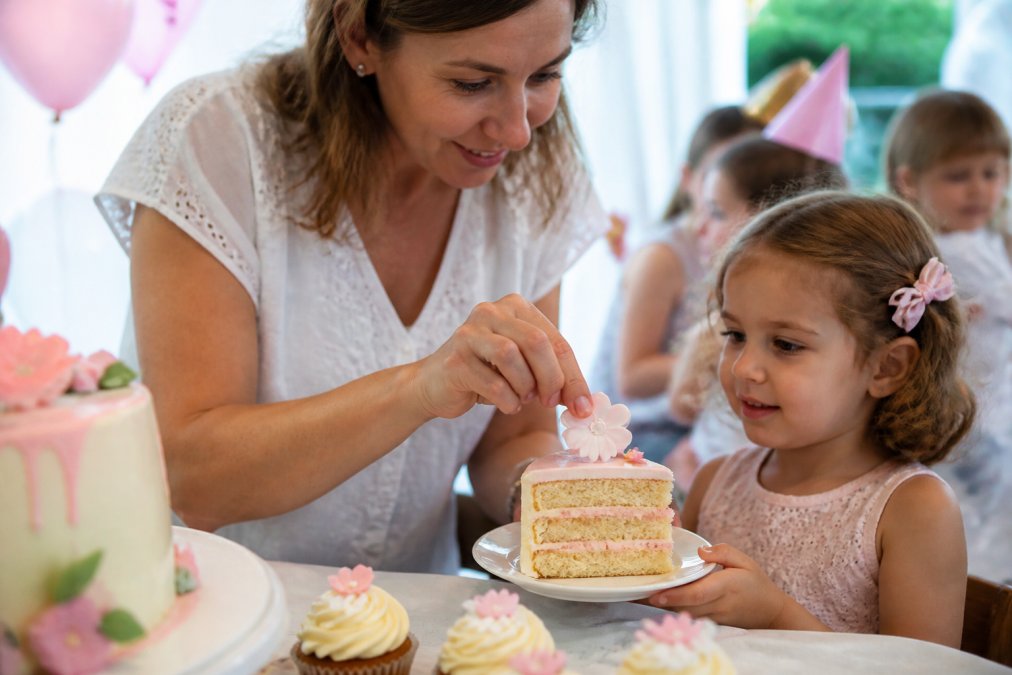
Children aged one to three are still learning to chew thoroughly and may attempt to swallow a topper whole. This is why many paediatric health organisations advise against giving young children any hard or chewy confectionery, and the same logic applies to cake decorations. The NHS publishes guidance on choking prevention and first aid for babies and young children, which recommends cutting food into small, manageable pieces and supervising young children while they eat.
How to Reduce Choking Risks for Toddlers
For toddlers and young children, the safest approach is simple: remove the topper before serving. If you want them to enjoy it, break off a small piece and soften it in buttercream or frosting first.
A practical checklist for serving cakes to young children:
- Remove all toppers from slices served to children under four
- Cut any edible topper into small pieces no larger than a fingernail
- Offer water or milk alongside the cake to help wash down any residue
- Supervise young children throughout the celebration, not just at the first bite
- Keep non-edible decorations, candles, and holders well away from serving plates
Understanding Allergen-Friendly Cake Toppers
Allergen-friendly cake toppers are decorations made without common allergens such as dairy, gluten, eggs, or nuts, so children with food allergies can enjoy them safely. For parents planning a party, checking the ingredient list is just as important as checking the cake itself.
Many commercial toppers contain gelatine or are made in facilities that handle nuts and gluten, so cross-contamination is a real concern. Simply Toppers has made all its sugar paste toppers 100% vegan, vegetarian, and free from dairy and gluten since 2013, so our decorations suit most common dietary needs.
Food allergen labelling regulations in the UK require businesses to provide accurate allergen information for pre-packed food, including cake decorations. When you buy from a specialist maker, you can verify exactly what is in the topper before it goes on the cake. If you're baking for a child with celiac disease or a nut allergy, always confirm the supplier's allergen policy directly rather than assuming a product is safe.
Edible vs Non-Edible Decorations: Spotting the Difference
The difference comes down to the materials used and how they are labelled. Edible toppers are made from food-grade ingredients and are safe to eat, while non-edible decorations are made from plastic, resin, wood, or other materials that must be removed before serving.
Confusion arises because many non-edible toppers look exactly like their edible counterparts. The safest habit is to assume a decoration is not edible unless the packaging clearly states otherwise.
If a topper arrives without any ingredient information or allergen labelling, treat it as non-edible. When in doubt, remove it from the cake entirely and use it only as a keepsake.
How to Store Edible Toppers and Check Shelf-Life
Proper storage keeps edible toppers fresh and safe to eat, and most will last for several months when kept in the right conditions. A topper stored incorrectly can develop mould, absorb moisture, or become a breeding ground for bacteria, even if it looks fine on the surface.
Storage Guidelines by Material
Wafer paper and icing sheets are the most forgiving to store. Keep them in their original sealed packaging in a cool, dry cupboard. Unopened wafer paper can last up to 12 months, while opened packs should be used within 3 months. Icing sheets are more sensitive to humidity, if the air is damp, they can become sticky.
Fondant and sugar paste toppers require more care. They should be stored flat in an airtight container, with each piece separated by parchment paper, away from heat and sunlight. Fondant toppers typically have a shelf-life of 4 to 6 months from the date of manufacture.
Handmade toppers with multiple colours or intricate details are more fragile. For these, follow the supplier's specific storage instructions. At Simply Toppers, we recommend keeping our handmade decorations in their original packaging until the day of the event, stored flat and away from any heat source. Since our toppers are handmade and can be custom made or ordered, you can request specific storage guidance when your order is confirmed.
Date Marking and Legal Requirements
Under the Food Information Regulations 2014, pre-packed food products sold in the UK must carry a 'best before' or 'use by' date. A 'best before' date relates to quality, while a 'use by' date relates to safety, the topper should not be eaten after this date under any circumstances.
When you buy a topper, check that the packaging carries a clear date mark. If it does not, this is a compliance failure on the seller's part. A reputable maker will always provide a date mark and storage instructions.
The Cross-Contamination Risk in Your Home
A less obvious risk is cross-contamination during storage. Edible toppers are porous, they can absorb odours and contaminants from their surroundings, so keep them away from cleaning products and raw meat.
To minimise this risk:
- Store toppers in a dedicated airtight container, separate from non-food items
- Never store toppers in the fridge unless the supplier explicitly advises it, condensation can ruin the surface and introduce moisture
- Keep toppers away from strong-smelling foods, as they can absorb flavours
- Wash your hands before handling toppers, and use clean utensils when cutting or positioning them
A Pre-Serving Inspection Checklist
Before placing any topper on a cake, run through this checklist:
- Check the date mark, if the 'best before' date has passed, assess the topper's condition carefully. If it is past the 'use by' date, discard it.
- Inspect the surface, look for any signs of mould, which may appear as small dark spots or a fuzzy texture. Mould can grow on sugar-based products if they have been exposed to moisture.
- Smell the topper, a fresh topper should have a neutral, slightly sweet aroma. Any sour, musty, or chemical smell means it should be discarded.
- Feel the texture, a wafer paper topper should be crisp and dry. If it feels damp or sticky, it has absorbed moisture and may not be safe. A fondant topper should be firm but pliable. If it is rock hard or crumbly, it has dried out.
- Check for discolouration, fading or bleeding colours can indicate age or improper storage, which may affect both appearance and safety.
:::warning If an edible topper has been stored in a fridge, allow it to come to room temperature in its sealed packaging before opening. This prevents condensation from forming on the surface, which can cause colours to bleed and create a damp environment where mould can develop.
Ordering Ahead: A Practical Timeline
For custom-made toppers, order well ahead of your event and store them correctly until the day. A sensible timeline is:
- Order 2 to 3 weeks before your event, this allows time for production and delivery, and gives you a buffer if the topper arrives damaged.
- Store flat in original packaging, do not stack heavy items on top of the topper, as this can cause bending or cracking.
- Inspect on arrival, check the topper as soon as it arrives. If it is damaged, contact the supplier immediately. Most reputable makers will replace a damaged topper if you report it within 48 hours.
- Apply on the day, for best results, position the topper on the cake no more than a few hours before serving. This keeps it fresh and vibrant.
A topper stored correctly will look just as good on the cake as it did the day it arrived. But if you have any doubt about its condition, the safest choice is to discard it and serve the cake undecorated. A missing topper is a minor disappointment; a food safety incident is not.
Best Practices for Serving Cakes with Edible Toppers
Serving a cake with edible toppers safely comes down to three habits: know what's on the cake, tell your guests, and remove anything that shouldn't be eaten.
For children's parties, place the cake where adults can serve the slices. Announce clearly which parts of the cake are edible, especially if you've used a mix of sugar paste and plastic decorations.
If you're using handmade sugar paste toppers, like those from Simply Toppers, they can be eaten along with the cake or removed and kept as a keepsake. Position the topper just before serving so it stays fresh and vibrant, and store any unused toppers in their original packaging.
Conclusion: Make Informed Choices for Your Celebration
There are no legal age restrictions on using edible toppers, but the practical guidance is clear: supervise young children, remove decorations from slices for under-fours, and always confirm allergens before serving.
At Simply Toppers, we've spent over a decade creating handmade sugar paste decorations that are inclusive for everyone. Our toppers are 100% vegan, vegetarian, and free from dairy and gluten, so you can decorate with confidence knowing every guest can join in. Whether you're planning a birthday, baby shower, or holiday celebration, browse our range of handmade and custom designs to find the perfect finish for your cake. Get started with Simply Toppers and make your next celebration safe, beautiful, and memorable for all the right reasons.
Frequently Asked Questions
Are edible cake toppers safe for toddlers?
Edible cake toppers are safe for toddlers to eat, but supervision is essential. Toddlers under three years old are at higher risk of choking on any food, including sugar paste. Remove the topper from the cake and cut it into small, manageable pieces before serving. Check the ingredients list for common allergens and always watch young children while they eat.
Do edible cake toppers contain common allergens?
It depends on the brand. Many standard toppers contain dairy, gluten, or other allergens. Look for allergen-friendly cake toppers that are clearly labelled vegan, dairy-free, and gluten-free. Always read the packaging carefully and check for 'may contain' warnings. When in doubt, contact the manufacturer directly to confirm their production processes.
How should I store edible cake toppers to keep them safe?
Store edible toppers in a cool, dry place away from direct sunlight and humidity. Keep them in their original packaging or an airtight container until you are ready to use them. Check the use-by date before decorating your cake. Once applied, cakes with sugar paste toppers are best eaten within a few days for the best taste and texture.
What is the difference between edible and non-edible cake decorations?
Edible toppers are made from food-grade materials like sugar paste, wafer paper, or icing sheets and are safe to consume. Non-edible decorations include plastic figurines, wooden picks, or paper flags. Always read the label to confirm. Remove all non-edible items before serving the cake, especially if children are present.